

Research
Research Mission
The Office of Research mission is directly aligned with AUS’ vision to be a globally recognized institution that promotes innovation and knowledge creation. By prioritizing interdisciplinary and collaborative research, the Office of Research is committed to advancing knowledge while supporting AUS’ goal of providing an educational experience that emphasizes creativity, innovation and academic excellence. Research efforts are strategically aligned with both local and international priorities, contributing to the advancement of knowledge and ensuring that our work has a lasting, meaningful impact. This supports AUS’ mission of contributing to society through knowledge, leadership and progress.
The research mission is guided by the following core principles:
- establish, and continually evolve, interdisciplinary, collaborative research and creative work
- align research with local and international priorities
- achieve research impact through a focus on research with both local and global importance
University Research and Creative Works Council

Research governance at AUS is implemented by the University Research and Creative Works Council (URCWC). The URCWC advises the Vice Chancellor for Research in developing and managing the AUS research enterprise, ensuring that academic and research activities are well aligned. The council creates a supportive environment for research and creative works by shaping research strategies and action plans, reviewing and recommending policies, budget allocations, facility space, staffing and infrastructure needs, and ensuring that funding and innovation agendas, as well as undergraduate and graduate programs, are closely integrated with research objectives. The URCWC also actively identifies opportunities for external collaborations and addresses any relevant matters brought forth by its members.
Research Leadership

Dr. Steven Griffiths | Vice Chancellor for Research
The Vice Chancellor for Research (VCR) provides strategic leadership and institutional oversight of research and innovation, reporting to the Chancellor and serving on the senior leadership team. The role defines the university’s research vision and governance framework, ensuring alignment with institutional priorities and fostering a culture of research excellence, collaboration and impact. The VCR oversees the full research ecosystem, including infrastructure, centers, services and innovation, and leads institutional policy, funding strategy and investment in research capability. The role ensures robust systems for research integrity, ethics and compliance; advances intellectual property and commercialization pathways; and cultivates regional and international partnerships. In addition, the VCR provides executive stewardship of research resources and works closely with academic leadership to integrate research with teaching and graduate education. Read more
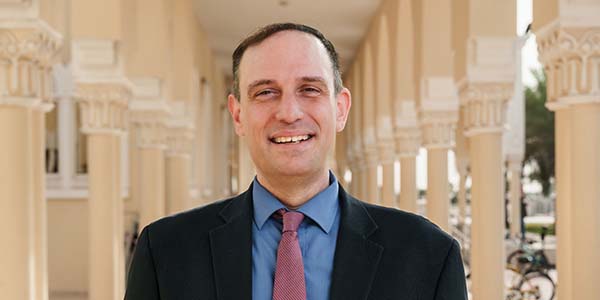
Dr. Ghaleb Husseini | Associate Vice Chancellor for Research
The Associate Vice Chancellor for Research (AVCR) provides strategic leadership for the governance, development and performance of university research centers. The role implements frameworks for center creation, evaluation and performance management to ensure alignment with institutional research priorities and impact objectives. The AVCR works closely with research center directors and college leadership to support interdisciplinary research, effective resource allocation and sustainable center performance. The role also contributes to institutional research strategy, represents the Vice Chancellor for Research as required, engages with external stakeholders to strengthen partnerships, and supports policy and funding initiatives that enhance research center impact and sustainability. Read more

John Radkowski | Executive Director for Research Services
The Executive Director for Research Services (ED-RS) provides strategic and operational leadership for research support functions, enabling high-quality and competitive research across disciplines. The role implements the university’s research strategy through oversight of grants and contracts, internal funding programs, research systems, intellectual property management, and research performance and evaluation frameworks. The ED-RS strengthens institutional research capacity and funding competitiveness while ensuring effective frameworks for research integrity, quality assurance and compliance. The role also builds partnerships with industry, government and funding bodies to enhance research opportunities and impact. In addition, the ED-RS leads research services teams and promotes a culture of service excellence, continuous improvement and responsive support for researchers. Read more
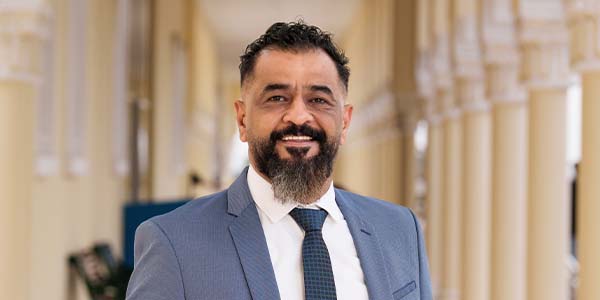
Dr. Ali Alnaser | Associate Vice Chancellor for Research Infrastructure
The Associate Vice Chancellor for Research Infrastructure (AVCRI) provides strategic leadership for AUS research laboratories and research computing environments. The role defines and advances the framework for shared research infrastructure, ensuring safe, efficient and future-ready facilities aligned with institutional research priorities. The AVCRI works across academic, technical and administrative units to strengthen laboratory capability, optimize space and equipment planning, and support high-performance research environments. The role also advances research computing capacity, including high-performance computing and data infrastructure, in partnership with ICT and IT security, and supports strategic investment and funding initiatives for research infrastructure. Read more
Themes and Impact
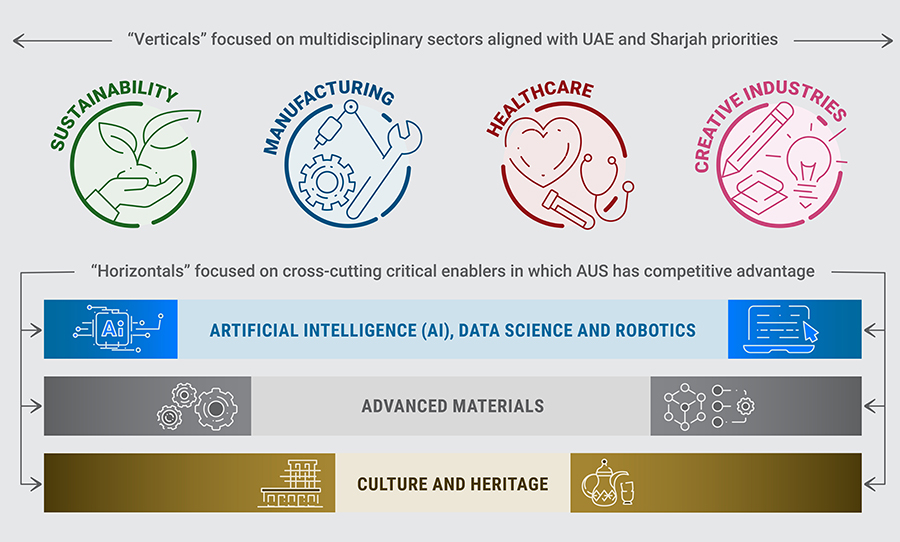
AUS research is guided by the UAE’s evolving priorities as well as Sustainable Development Goals.
Endowed Chairs and Professorships
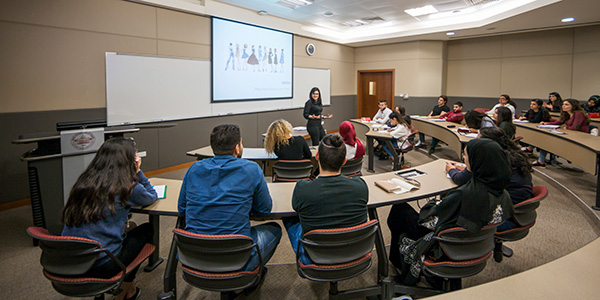
Endowed chairs and professorships at AUS recognize its faculty’s outstanding contributions to research, innovation and academic excellence. These distinguished positions attract top scholars who lead impactful research, mentor future leaders and drive interdisciplinary collaboration in key areas such as sustainability, technology and social innovation. They also reflect AUS’ strong partnerships with donors who share its commitment to education and discovery.
Research Centers
AUS' research centers offer dynamic environments for faculty, researchers and students to collaborate on research aligned with Sharjah's priorities. The centers actively collaborate with Sharjah Research Technology and Innovation Park (SRTIP) and Sharjah’s entrepreneurship center Sheraa to translate fundamental research into innovative solutions and industry partnerships, driving economic growth and contributing to the development of a knowledge-based economy.

- Materials Research Center (MRC)
Provides advanced materials characterization and fabrication services, integrating specialized equipment, technical expertise and research support. It offers both academic and industrial partners access to advanced instrumentation and training programs, enabling groundbreaking and impactful research.

- Center for Entrepreneurship and Innovation (CEI)
Collaborates with strategic partners in Sharjah to translate the research innovations and promising ideas of students and faculty members into marketable solutions. It focuses on sustainable development and catalysts for sustainable growth, particularly entrepreneurship and innovation.

- Energy, Water and Sustainable Environment Research Center (EWSERC)
Focuses on practical solutions for rising resource demands in urban areas, and advancing research in energy, water and environmental sustainability. Through sustainable solutions, it optimizes resource use and develops new technologies and infrastructures to address global challenges.

- Center for Biomedical Innovations (CBI)
Tackles local and global healthcare challenges by advancing innovative research, leveraging state-of-the-art technologies, and fostering collaborations to enhance healthcare outcomes and benefit communities.

- AI, Robotics and Connected Infrastructure Center (ARC)
Focuses on machine learning, computer vision, natural language processing, robotics, and smart digital infrastructure, including their ethics and business strategies. Research includes AI-driven smart city management, autonomous transportation, IoT-enabled infrastructure, and ethical frameworks for AI and robotics in healthcare, business, and urban development.

- Center for Arab Studies and Islamic Civilizations (CASIC)
Emphasizes the study of the Arabic language, heritage, history, arts and cultures of the Arab and Islamic worlds, offering a specialized perspective that complements and challenges Western approaches to studying Arab and Islamic civilizations.
AUS is currently recruiting for the position of Director of CASIC. To learn more and apply, visit our employment page.

- Center for Geospatial Intelligence (CGI)
Advances research in artificial intelligence, remote sensing and geospatial technologies to develop actionable intelligence for challenges in water security, energy transition, environmental monitoring and smart city development. Through GeoAI-driven solutions, it supports sustainable resource management, resilient systems and data-informed decision-making in the UAE and beyond.
Research Services
The Office of Research Services (ORS) provides high-quality support to campus research, creative activity and outreach initiatives. It helps identify research opportunities and partnerships, facilitates the submission of sponsored projects, negotiates and executes research agreements, provides research education and communication, and assists faculty, staff and students in managing projects awarded by and to the university. It maintains relevant policies, supports research integrity and the ethical conduct of research, and promotes university-wide interdisciplinary research collaboration for both basic and applied research aligned with the needs of the UAE and the region.
For more information, contact [email protected].
- Pre-award
The pre-award team supports researchers in securing external funding. The team serves as a bridge between researchers, funding organizations and collaborators, ensuring that all pre-award activities align with institutional policies and sponsor guidelines.
Key services include:
- identification and dissemination funding opportunities
- guidance and support for proposal development and submission
- negotiation and management of research contracts and subawards
- monitoring research and financial progress to ensure project success
- compliance with sponsor requirements and institutional policies
The team processes awards and contracts with support from Technology Transfer and General Counsel. It coordinates the negotiation, development and management of research-related agreements as well as ensures that all agreements align with institutional policies, sponsor requirements and regulatory standards.
The pre-award team assists with the following types of agreements:
- industry-sponsored research agreements
- research collaboration agreements
- master research agreements with strategic partners
- subcontracts or subawards
- sponsored research fellowships or studentship agreements
- Memoranda of Understanding (MoUs)
- letters of intent/support/commitment accompanying research proposals
- equipment loan agreements
For inquiries, contact the pre-award team at ors@aus.edu.
- Post-award
The post-award team provides leadership in research administration, supports research endeavors and ensures the responsible stewardship of research funding. The team works closely with principal investigators (PIs) and their administrative staff to deliver comprehensive post-award services that uphold compliance and financial accountability.
Key services include:
- centralized management of sponsored research awards
- guidance to PIs and administrative staff to ensure compliance with award terms, conditions and AUS policies
- oversight of invoicing, financial reporting, budget management, cash deficit monitoring and final account reconciliations
- collaboration with administrative staff on effort and cost allocation, re-budgeting requests and account closeout processes
- coordination with finance and budgeting teams on grant-related matters
- development and implementation of sponsored program administration policies and procedures
- creation and delivery of training materials and programs to enhance research administration capabilities
For inquiries related to award management, including policies, procedures, budget changes, financial issues or approvals, please contact the post-award team at [email protected].
- Technology Management
Technology transfer is the process of transforming innovations into new products or services that benefit society. At AUS, the Technology Transfer Office (TTO) plays a crucial role in supporting faculty, staff and students in commercializing their innovations. Through strategic industry collaborations and partnerships, particularly with the Sharjah Research, Technology and Innovation Park (SRTIP), AUS fosters the development of cutting-edge solutions across multidisciplinary fields.
Key services include:
- facilitation of technology transfer: connecting researchers with industry partners to bring innovations to market
- protection of intellectual property (IP): including patents, know-how, copyrights and trademarks through structured identification, evaluation and legal protection
- assessment of commercial potential: evaluating the viability of innovations, guiding researchers in securing IP protections and maximizing commercial opportunities
- expert guidance: supporting innovators at every stage, from IP protection to commercial strategy, ensuring research is effectively translated into societal benefits
- enhancing industry collaborations: accelerating, through the university’s strong partnership with SRTIP, the transition of research discoveries to market-ready solutions that contribute to economic growth
Intellectual Property Agreements
The Technology Portfolio Team is responsible for negotiating certain non-funded agreements that relate to AUS intellectual property. For the agreements below, please send an email to [email protected].
- Technology licensing agreements
- Material transfer agreements for sharing research materials or research tools
- Data transfer agreements
- Data processing agreements
- Equipment loan agreements
Click here for the Intellectual Property Disclosure Form (IPDF).
- Research Systems
The Research Systems team works closely with various departments to ensure that research systems are user-friendly, efficient and aligned with institutional needs.
Key services include:
- supporting the research lifecycle: facilitating seamless operations across both pre- and post-award phases, ensuring faculty members receive the necessary support at every stage
- pre-award phase: managing and optimizing systems for grant applications, streamlining submission processes and enhancing accessibility
- post-award phase: overseeing reporting mechanisms for project execution, ensuring compliance and effective tracking of research activities
- workflow configuration and data management: designing and implementing structured workflows, managing research data and providing timely insights to stakeholders
- reporting and decision support: generating comprehensive reports for data-driven decision-making and monitoring research progress effectively
For more information, contact [email protected].
- Internal Funding and Research Impact
Internal funding programs form the backbone of AUS’ research ecosystem, providing faculty members with essential opportunities to pursue innovative research. ORS develops and structures these programs to align with institutional priorities and strategic goals. In addition to funding research, ORS actively measures and enhances the impact of these investments to ensure meaningful contributions to academia and society.
Key services include:
- design and management of funding programs: creating and overseeing internal funding initiatives tailored to support diverse research needs
- administration of submission process: ensuring clarity and accessibility for all applicants, streamlining proposal submissions and facilitating a fair, transparent application experience
- rigorous evaluations: conducting a structured and impartial review process, assessing proposals to ensure that funding is allocated to high-quality, impactful research
- coordination of fund allocation: managing the timely disbursement of funds to successful applicants, supporting research projects from inception to completion
- tracking and evaluating research impact: monitoring research outputs, including publications, citations and patents, while assessing the return on investment of funding programs
- research productivity enhancement: using performance data to identify opportunities for increased collaboration, innovation and academic recognition
- showcasing research achievements: highlighting the real-world impact of AUS research to stakeholders, including students, industry, government and the broader community
Current Internal Funding Opportunities: Click Here
- Institutional Review Board (IRB)
The AUS IRB strives to help you make sure your research complies with applicable regulations, relevant ethical standards, and any legal and institutional requirements. All AUS members must ensure that any research involving human subjects is formally reviewed and approved by the AUS IRB before initiating data collection or contacting participants.
All IRB forms and policy documents are available on iLearn under Research Services.
Kindly note that the IRB will take 2-4 weeks to review any new IRB protocols during Fall/Spring and 4-6 Weeks during Summer.
For more information, or to initiate the IRB process, please contact [email protected].
Collaborative Institutional Training Initiative (CITI)
CITI training certification is mandatory for all AUS researchers (PI, faculty supervisors, and all Co-Is from AUS) to submit a successful IRB application/protocol to the AUS IRB. AUS researchers need to finish either the Social-Behavioral-Educational Researchers training or the Biomedical Researchers training under the Human Subjects Research (HSR) course for the IRB application submission.
Please log in with the option “Log In Through My Organization” and select American University of Sharjah (AUS), using Single Sign On (SSO). The first time you log in, you will need to select the radio button “I don’t have a CITI Program account and I need to create one.” Then, click on “View Courses” and then “Add a Course” to select HSR. A step-by-step guide is also available in iLearn.
Infrastructure
AUS boasts a sophisticated research infrastructure, led by the AUS Associate Vice Chancellor for Research Infrastructure, that is designed to advance cutting-edge scientific and engineering exploration across diverse disciplines. Equipped with state-of-the-art instrumentation, these specialized facilities empower researchers to conduct investigations in areas such as water, energy, sustainability, bioscience, biomedical engineering, materials science, construction and smart infrastructure.
Each facility is meticulously designed to deliver comprehensive research capabilities, featuring precision instruments for detailed analysis, fabrication and material characterization. The infrastructure reflects the university’s commitment to interdisciplinary research, supporting complex experimental protocols and fostering innovative scientific discoveries.
Core facilities encompass a wide array of scientific domains, including:
- advanced manufacturing and laser processing
- analytical chemistry
- surface and coating characterization
- mechanical testing
- high-resolution microscopy
- biomedical and neuroengineering
- spectroscopic analysis
- construction and smart infrastructure research
- functional and electronic materials research
This extensive suite of facilities provides researchers with the technological foundation to push the frontiers of scientific knowledge, develop pioneering technologies and address complex challenges across multiple domains.
- Additive Manufacturing and Laser Processing
3D Printing:
- Fuse 1 (SLS 3D Printer): Produces complex geometries in nylon materials
- Project MJP 3600 Max: High-resolution multi-jet printing for detailed prototypes
- Sharebot Metal One and Farsoon FS121M-E: Specialized for metal 3D printing
- Laser Processing:
- Universal Laser Cutters: Precision systems for various materials
- High-Power Ultrafast Fiber-Laser System and Femtosecond Laser Oscillator: For advanced material processing and ultrafast spectroscopy
- Pulsed Laser Deposition System: Thin film deposition for materials science
- CNC Machines:
- CNC VMC Mini Mill (HAAS SMM-2) and CNC Routing Machine: Precision cutting and shaping capabilities
- Analytical Chemistry
- Chromatography and Mass Spectrometry:
- Micro GC (Agilent 990): Rapid gas sample analysis
- GC-MS (Shimadzu) with Thermal Desorber: For analyzing complex organic mixtures
- HPLC (Shimadzu Prominence): High-performance liquid chromatography
- Elemental and Organic Analysis:
- CHNS Analyzer (Eurovector EA3000): Elemental composition analysis
- TOC Analyzer (Shimadzu): Measures organic carbon in water
- Spectroscopy and Sample Preparation:
- NanoPhotometer N50 Touch: Nucleic acid and protein quantification
- Gas Sorption Analyzer (Anton-Paar Autosorb-iQ3): Surface area and porosity measurements
- Microwave Digestor (Anton Paar Multiwave): Sample preparation for analysis
- Chromatography and Mass Spectrometry:
- Microscopy
- High-Performance SEM (TESCAN): Ultra-high-resolution surface imaging
- Confocal Raman Microscope (WITec): Combines optical imaging with chemical analysis
- Digital Microscope (Zeiss Smart Proof 5): 3D surface topography
- Atomic Force Microscope (Nanomagnetics HpAFM): Nanoscale imaging and manipulation
- Coating and Surface Characterization
- Surface Analysis:
- X-Ray Diffractometer (XRD): Crystal structure analysis
- Drop Shape Analyzer: Measures surface energy through contact angles
- Coating Systems:
- Pulsed and Atomic Layer Deposition Systems: Thin film creation at the atomic level
- Thermal Evaporator and Spray Pyrolysis: Thin film deposition techniques
- Surface Analysis:
- Construction, Structures, and Smart Infrastructure
- VIC-3D Digital Image Correlation System: Measures surface deformation and strain
- Driving Simulator (NADS miniSim™): Studies driver behavior and environmental impact
- Electromechanical Dynamic Triaxial Testing System: Advanced soil property testing
- Mechanical Testing
- Split Hopkinson Bar System: Analyzes material behavior at high strain rates
- Universal Testing Machine: Performs tensile, compressive, and flexural tests
- Dynamic Mechanical Analyzer: Studies viscoelastic material properties
- Electronic and Functional Materials
- Advanced Measurement Systems:
- Physical Property Measurement System: Analyzes materials under extreme conditions
- Vector Network Analyzers: Measures high-frequency electronic systems
- Energy Research Tools:
- Solar Simulator and Fuel Cell Tester: Characterizes solar cells and fuel cells.
- Multichannel Potentiostats: Used for energy and biomedical research.
- Advanced Measurement Systems:
AUS Public Statement on Research Assessment
In the Spotlight
Contact Us
Mellane M. Agron
Office Manager
Office of Vice Chancellor for Research
Email | [email protected]
Tel | +97165152214