Latest News
October 13, 2026
October 13, 2026
October 12, 2026
October 12, 2026

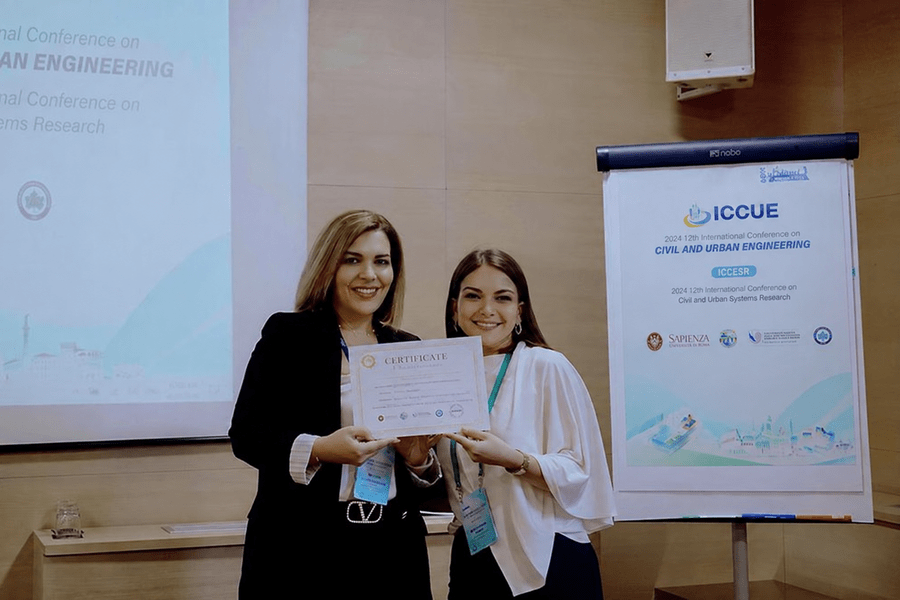
Research by American University of Sharjah (AUS) alumna Mounia Gharzeldeen earned her the Best Presentation Award at the 13th International Conference on Civil and Urban Engineering in Rome. Gharzeldeen holds two master’s degrees from AUS: a Master of Science in Engineering Systems Management, completed in 2011, and a Master of Science in Civil Engineering, completed in 2026. Conducted as part of her second master’s thesis, the research assesses whether concrete structures that remain standing after a severe fire retain sufficient strength and safety to be repaired or kept in service.
The study examined a full-size floor slab made from ultra-high-performance concrete, an advanced material known for its exceptional strength and durability. Measuring four meters long, one meter wide and 20 centimeters thick, the slab combined conventional steel reinforcement with steel and polypropylene fibers. It was exposed to a severe furnace fire while carrying 60 percent of its normal load capacity, allowed to cool naturally and then loaded again until failure. After the fire, it retained a load capacity of approximately 80 kilonewtons, compared with 104 kilonewtons under normal conditions, a reduction of about 23 percent. Despite the fire and permanent deformation, the slab remained intact and bent gradually before failure instead of collapsing suddenly.
Supervised by AUS Professors of Civil Engineering Dr. Rami Hawileh and Dr. Jamal Abdalla, the research involved academic and industry collaboration in the UAE and the United States, supported by AUS funding, facilities and laboratory expertise. Its findings could help engineers decide whether fire-damaged structures should be retained, repaired or replaced, potentially reducing unnecessary demolition, construction waste, rebuilding costs and carbon emissions. Gharzeldeen plans to continue expanding the research through further studies and publications on the fire and post-fire performance of ultra-high-performance concrete, with the longer-term aim of supporting more reliable structural assessments, effective rehabilitation methods and safer, more sustainable construction.

By continuing, you will be taken to a website not affiliated with American University of Sharjah. Links to external sites are provided only for users' convenience and imply no endorsement of the site and/or its content. Note that the privacy policy and security settings of the linked site may differ from those of the AUS website.