Latest News
October 21, 2026
October 20, 2026
October 19, 2026
October 15, 2026

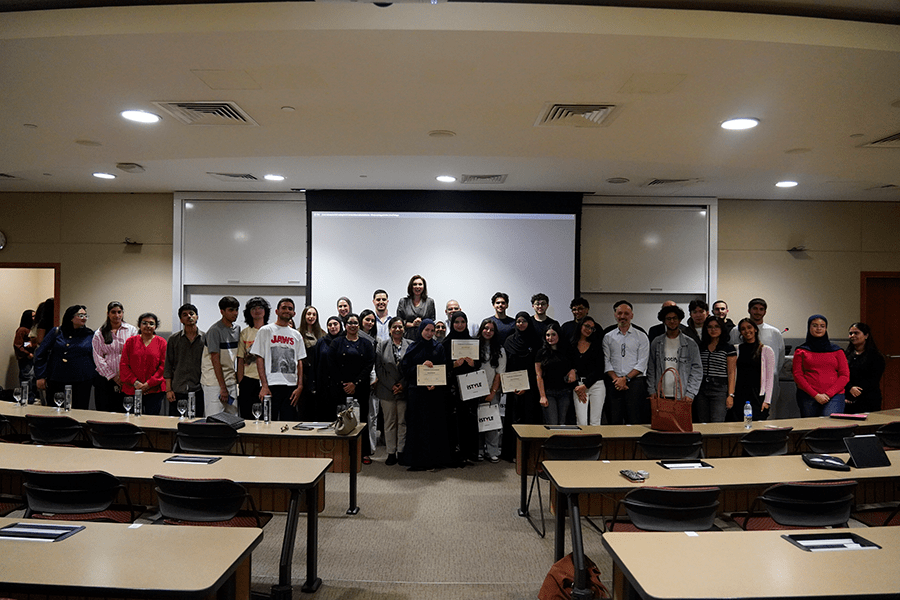
Students in the first cohort worldwide to complete the challenge reported setting savings goals, tracking budgets and adding to emergency funds.
As the UAE advances its National Financial Literacy Strategy, students at the American University of Sharjah’s (AUS) School of Business Administration (SBA) became the first cohort worldwide to complete NAYRA, a digital financial literacy challenge. After completing it, they reported greater confidence managing money, with many also saying they had set savings goals, tracked budgets or added to emergency funds.
Developed by EWA Group and delivered in partnership with Dubai Multi Commodities Centre and the UAE Ministry of Economy and Tourism. At AUS, the three-and-a-half-week challenge ran during the Fall Semester 2026 and covered money basics, financial stability, investing and wealth, and business finance. Daily lessons combined instruction, practice, quizzes and rewards, supported by spaced repetition, points, streaks, a live leaderboard and an AI guide designed to stay within educational limits.
Assessments before and after the challenge showed that the average financial confidence score among students assessed at both stages rose from 64 to 80 out of 100. NAYRA assessed students’ confidence in making sound financial decisions, managing setbacks such as lost income, and using digital payments and credit safely. Among students who completed assessments before and after the challenge, 89 percent recorded a higher score. Students who began with a score below 50 gained about 21 points on average, compared with about eight points among those who began at 70 or above. Students answered 78 percent of lesson questions correctly, giving SBA insight into topics that may need greater attention.
Students also self-reported changes in their financial habits after the challenge. Ninety-six percent said they felt more able to make financial decisions independently; 40 percent had set a savings goal; 36 percent had written down or tracked a budget; 34 percent had started or added to an emergency fund; and 31 percent had moved money into savings or investments.
For Dr. Narjess Boubakri, Dean of SBA, NAYRA extended the school’s focus on practical learning to students’ personal finances.
“At SBA, we connect academic learning with practical experience. Our students learn about markets on a live trading floor and prepare for the Chartered Financial Analyst Program. NAYRA applied that focus to the financial decisions they make in their own lives. It was rewarding to see students engage with the material and grow more confident. This is the kind of personal development that helps prepare the next generation of business leaders.”
She added: “Financial literacy is a global challenge, and the UAE’s National Financial Literacy Strategy is an important step in addressing it. As a university, AUS has a responsibility to contribute by equipping students with practical financial skills and measuring the impact of financial education.”
For Hawraa Mahdi, a finance student at AUS, the challenge connected what she studies in class with the financial decisions she makes every day.
“The NAYRA challenge let me bring my finance studies into everyday life, applying concepts like cash flow, true cost and risk to real decisions. More importantly, it made me more mindful of my daily spending, and I now manage my personal finances with a confidence I didn’t have before,” she said.
AUS honored the cohort at a ceremony attended by Dr. Boubakri; Dr. Mohsen Saad, Head of the Department of Finance at AUS, who led the course team and introduced NAYRA to his students; and members of AUS administrative staff. NAYRA’s three co-founders, Dame Yulia Stark, Anas Ech-Cherfi and Lucero Liriano Castillo, also attended. Students who completed the challenge received a certificate and three percent extra credit in the course. The three highest-scoring students each received an iPad.
Addressing the students, Stark said: “We started NAYRA with one belief: that financial confidence gives a young person freedom. Freedom to make their own choices, to pursue their ambitions, to build something of their own. That freedom should not depend on where someone comes from. You are the founding generation, and you are the proof.”
NAYRA is developing the Financial Confidence Index, a research tool for economists and policymakers to compare how confidently people manage money and examine its links to household resilience, entrepreneurship and economic growth.
For more information about SBA, visit www.aus.edu/sba.
By continuing, you will be taken to a website not affiliated with American University of Sharjah. Links to external sites are provided only for users' convenience and imply no endorsement of the site and/or its content. Note that the privacy policy and security settings of the linked site may differ from those of the AUS website.