Latest News
October 27, 2026
October 27, 2026
October 26, 2026
October 26, 2026

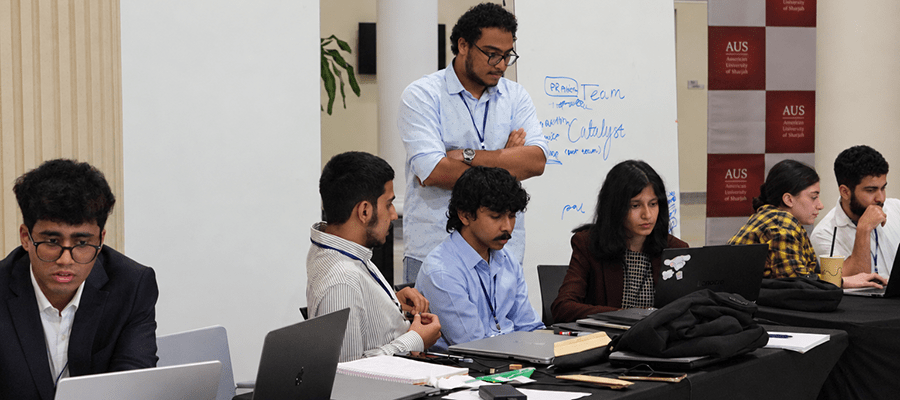
More than 100 participants formed interdisciplinary teams to develop ideas for hospitals, pathology laboratories and emergency room operations
American University of Sharjah (AUS) hosted the Nexus 2026 Design Competition on campus on October 24, bringing together more than 100 undergraduate students from universities across the UAE. The competition invited students to apply their knowledge to healthcare challenges that call for expertise from several fields.
Led by the AUS student branches of the American Society of Heating, Refrigerating and Air-Conditioning Engineers (ASHRAE) and the Engineering in Medicine and Biology Society of the Institute of Electrical and Electronics Engineers (IEEE EMBS), the competition brought together students from engineering, sciences, medicine and computing.
The competition featured three tracks. The engineering track focused on hospital facility design and optimization, including mechanical systems, heating, ventilation and air conditioning, biomedical engineering, and electrical engineering applications such as automation, controls and smart hospitals. The sciences track challenged students to design and optimize pathology laboratories. In health informatics, teams developed digital platforms to improve data analysis and emergency room operations.
The event opened with remarks from AUS academic and engineering leaders, followed by an overview of the competition tracks and judging criteria. Teams developed projects at dedicated stations and presented track-specific deliverables, which judges evaluated for technical quality, innovation, feasibility and adherence to industry standards.
Professionals from industry, healthcare and academia served as judges and mentors: Ahmed Hamdy of Honeywell; Ossama Dahabreh of Meindhart Group; Mohamad Assad of Dubai Health; Dr. Yaser AbuHajjaj of The Medical Office; Dr. Osama Salameh of Qasimia Hospital; Jamal Masalma of Emirates Health Services; Dr. Mohamed Abdelshakour of Sheikh Khalifa Medical City – Ajman; Dr. Irfaan Akhter of Mediclinic Middle East; and Dr. Majid Warkiani, professor in AUS’ Department of Mechanical Engineering.
“Nexus 2026 brought students from different fields together to work on challenges grounded in the realities of healthcare,” said Omar Shraim, a senior mechanical engineering student and president of the ASHRAE AUS Student Branch. “We wanted students to experience what it takes to apply industry standards and develop ideas in response to practical healthcare challenges.”
Rima Abu Tuaimeh, a junior chemical engineering student and president of the IEEE EMBS AUS Student Branch, emphasized the value of giving students a practical setting to explore healthcare challenges.
“The competition gave students a practical way to explore how engineering, science and technology can contribute to healthcare. It was rewarding to see teams bring different perspectives to a shared challenge,” she said.
“Competitions like Nexus help students connect what they learn in their disciplines with the complex needs of healthcare settings,” said Dr. Mamoun Abdel-Hafez, Head of the Department of Mechanical Engineering at AUS. “Working across fields helps students develop ideas that are technically grounded and responsive to healthcare’s operational challenges.”
The first-place teams in the three competition tracks were team Synergy5 in engineering, team 23 in Sciences, and team Catalyst in Informatics. Team Synergy5 comprised Furaiz Shah, Chirag Jadhav, Nawfel Najaf Ul Haq Shaikh and Mahin Imran, all from Rochester Institute of Technology in Dubai. Team 23 comprised Maram Sadeq Alsuraihi and Meera Alqemi of Khalifa University, and Shahd Mohammad and Elenood Sati of AUS. Team Catalyst comprised Sulaiman AbuQamar, Bilal Alkhofash, Jannah Elmaghraby and Hala Ghanayem, all from Khalifa University.
Jannah Elmaghraby, a member of Team Catalyst, which won first place in the Health Informatics track, said the competition offered a valuable opportunity to learn and connect with fellow participants.
“I had a great time at Nexus 2026. The event was fun and well organized, and I enjoyed meeting so many people and making new friends. Participating in the Health Informatics track was especially valuable: I learned more about hospital systems and healthcare standards in the UAE, as well as the importance of preparing hospitals for emergencies and mass-casualty situations. Overall, it was an amazing experience, and I’m looking forward to the next one,” she said.
The competition was organized by the AUS Department of Mechanical Engineering in collaboration with the ASHRAE Falcon Chapter, and supported by Petrofac Research Chair in Renewable Energy.
“Healthcare facilities rely on complex systems that must support patient care while using resources efficiently. Nexus gives students an opportunity to consider these needs from different disciplinary perspectives and explore how thoughtful design can contribute to more sustainable healthcare environments,” said Dr. Amani Al-Othman, Professor of Chemical and Biological Engineering and Petrofac Endowed Chair in Renewable Energy at AUS.
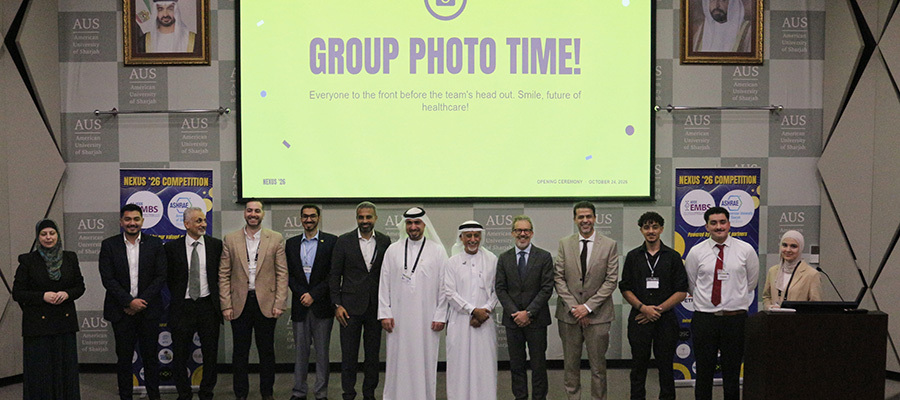
Thirteen additional student clubs supported the event’s track development, communications, media and volunteering: the Intelligent Systems and Mechatronics Engineering Club; American Institute of Chemical Engineers; Institute of Civil Engineers; IEEE Communications Society; Games Development Club; IEEE Computer Society; Pre-Med Club; Networks and Information Technology Club; Society of Cybersecurity; Network of Students in Medicine and Health; American Society for Biochemistry and Molecular Biology; Physics Club; and Open Source Club.
AUS provides a student experience that extends beyond the classroom. More than 130 student-led clubs and organizations provide opportunities across academic, cultural, creative and interest-based areas. For more information about student clubs and organizations at AUS, visit www.aus.edu/life-at-aus/student-life/clubs-and-organizations.
By continuing, you will be taken to a website not affiliated with American University of Sharjah. Links to external sites are provided only for users' convenience and imply no endorsement of the site and/or its content. Note that the privacy policy and security settings of the linked site may differ from those of the AUS website.