Latest News
October 26, 2026
October 22, 2026

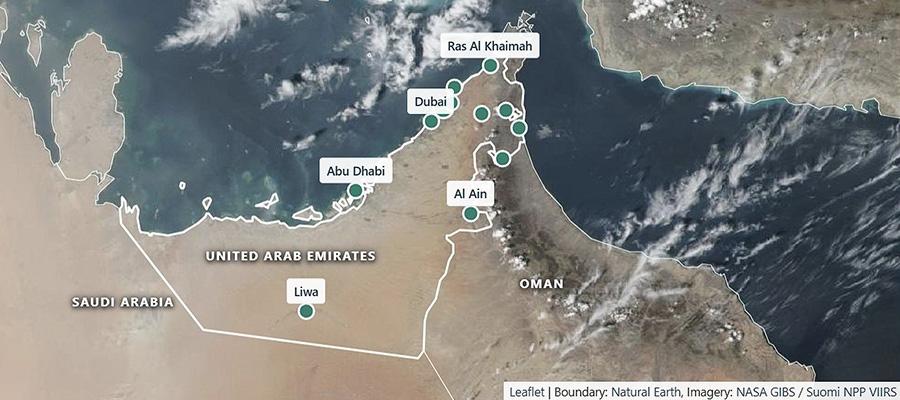
The prototype platform connects the El Niño–Southern Oscillation (ENSO), a climate cycle in the tropical Pacific, to heavy rainfall risk in the UAE.
A research team at American University of Sharjah (AUS) has introduced a pioneering climate intelligence initiative at the Center for Geospatial Intelligence (CGI). The team, which includes Dr. Tarig Ali, Dr. Hosni Ghedira, Dr. Gowhar Meraj and Dr. Rabin Chakrabortty, is advancing research into how large-scale climate variability relates to seasonal and heavy rainfall events in the UAE. Using the links between large-scale global climate patterns and local climate events in the UAE, the team has translated their work into a prototype digital El Niño–Southern Oscillation Climate Risk Observatory (ENSO–CRO).

As the UAE continues to experience urban growth alongside evolving weather patterns, enhancing national climate preparedness becomes an automatic priority. While short-term weather forecasts provide immediate alerts, long-term strategic planning requires a deeper understanding of how seasonal and macro-scale climate phenomena influence regional weather. This AUS faculty research directly supports the UAE’s national efforts to enhance climate preparedness, fortify urban drainage, manage water resources, and protect critical transport and coastal infrastructure against extreme weather volatility while providing decision-makers with advanced environmental information about weather disruptions.
“The importance of climate preparedness cannot be overestimated due to its implications for urban environment preparedness and long-term planning to mitigate any potential issues due to global weather patterns,” said Dr. Chakraborrty. “Through our work, we look to provide the relevant national authorities with tangible information points to better help them make informed decisions.”
Bridging the gap between global weather patterns and local disruptions, the team investigated the El Niño–Southern Oscillation (ENSO), a recurring ocean-atmospheric cycle originating in the tropical Pacific. Until now, understanding how this distant Pacific phenomenon specifically influences heavy rainfall episodes in an environment like the UAE remained a complex challenge.
By analyzing extensive hydroclimate datasets spanning over four decades, including NASA POWER, ERA5-Land, CHIRPS and NASA Global Precipitation Measurement IMERG records from January 1991 to July 2026, the AUS researchers have shown that warmer ENSO conditions directly correlate with more frequent rainfall extremes and greater regional coherence of heavy rainfall in the UAE. These assessments clarify how large-scale climate information can contribute to understanding rainfall risk and identifying priorities for monitoring.
"By looking at decades of hydroclimate records, our analysis demonstrates that warmer ENSO phases directly increase the frequency and regional synchronization of extreme rainfall events across the UAE," stated Dr. Ali. "This is a statistical linkage that gives us a robust scientific foundation to move beyond standard short-term forecasting and to better interpret macro-scale moisture anomalies in an arid environment."
Moving beyond traditional academic publication, the researchers also transformed these complex insights into an interactive, high-tech digital pilot platform labelled the UAE ENSO Climate Risk Observatory.
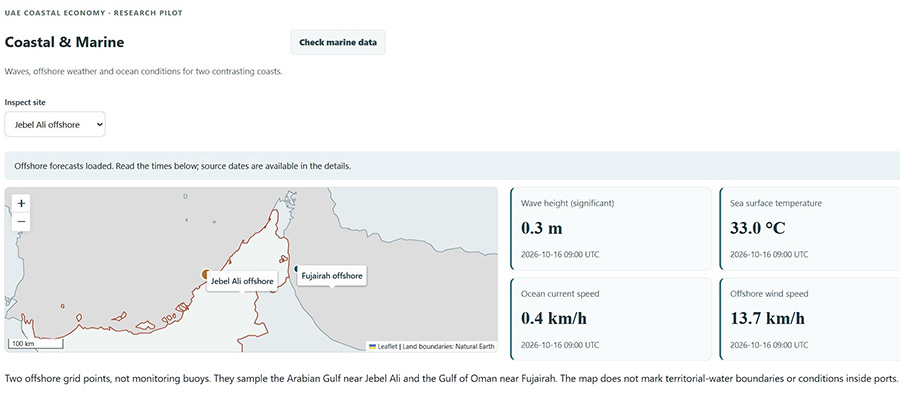
Designed to be accessible to decision-makers and non-specialists alike, the observatory merges historical ENSO relationships, satellite rainfall estimates, weather forecasts and interactive graphical summaries into a unified dashboard and brings this seasonal evidence into a common interface with location-specific weather information and sector-oriented explanations. Key features of the platform include the following:
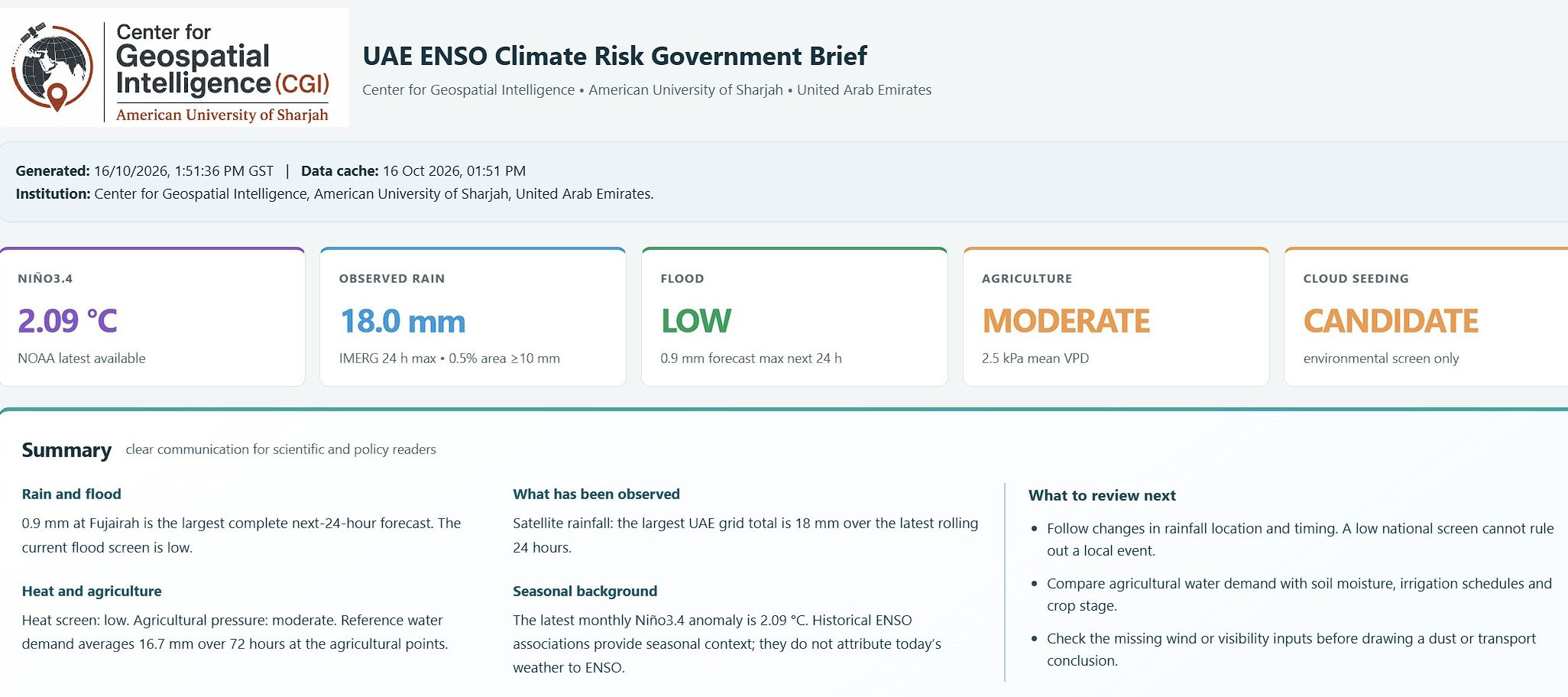
Crediting the research infrastructure at AUS, Dr. Hosni added, "Using advanced spatial analytics and computation, our team was able to translate these multi-decadal models into an operational geospatial dashboard. The AUS Center for Geospatial Intelligence and our research leadership provided the ideal environment for our team to build this scalable web-GIS framework for national climate resilience."
The active pilot under testing is configured to retrieve updated satellite rainfall and marine forecast data. The research team emphasizes that the platform serves as a supportive situational awareness tool for planning and preparedness, while official weather warnings remain strictly the responsibility of designated competent national authorities.
"Our ultimate goal with the ENSO–CRO is to empower local communities and national infrastructure planners with predictive intelligence," noted Dr. Meraj. "By bridging the gap between global climate cycles and localized impact models, we are laying the foundation for a more resilient, climate-adaptive future across the United Arab Emirates."
This research work highlights the growing leadership of AUS in addressing critical regional challenges through applied research in advanced geospatial analysis. By fostering cross-disciplinary inquiry among its faculty, AUS continues to deliver actionable solutions that support government strategies while securing a sustainable, climate-resilient future for the UAE.
To learn more about the research centers at AUS, visit www.aus.edu/research.

By continuing, you will be taken to a website not affiliated with American University of Sharjah. Links to external sites are provided only for users' convenience and imply no endorsement of the site and/or its content. Note that the privacy policy and security settings of the linked site may differ from those of the AUS website.