Nafs: Undergraduate Journal of Psychology
Nafs: Undergraduate Journal of Psychology is a student-run, faculty-advised publication within the Department of Psychology at AUS. It provides a scholarly outlet for high-quality undergraduate research and academic writing, giving students the opportunity to take their work beyond the classroom while gaining hands-on experience in academic publishing, peer review, research ethics and research dissemination. Named after the Arabic term associated with the self, psyche, or soul, Nafs reflects the journal’s focus on psychological inquiry and its regional identity.
MESSAGE FROM THE FOUNDER AND EDITOR-IN-CHIEF

Research is more than a course requirement. It is a way of asking questions, challenging what we think we know and bringing attention to experiences and perspectives that may otherwise go unheard. In a region as diverse and rapidly changing as ours, creating spaces to spotlight psychological research is especially important. We hope Nafs can contribute to that space by encouraging students to see their work as part of a broader academic conversation.
The idea for Nafs grew from noticing how intimidating research and publishing can feel when you are first introduced to them as a student. As students ourselves, we wanted to create something that makes that process feel more accessible while still maintaining the standards and care that scholarly work deserves. Through Nafs, students have the opportunity to experience the publishing process from beginning to end, engage with feedback and ultimately see their research published.
We hope Nafs becomes a space where curiosity is encouraged and students feel confident taking their first steps into academic publishing. |-BREAK-|
I look forward to seeing the questions you ask, the ideas you explore and the research that grows through Nafs. And whether you are here to contribute your own work or simply curious to read and discover what your peers are researching, I hope you will find something here that makes you want to keep asking questions.
Fahimah Saiyed
Founder and Editor-in-Chief
Editorial Board
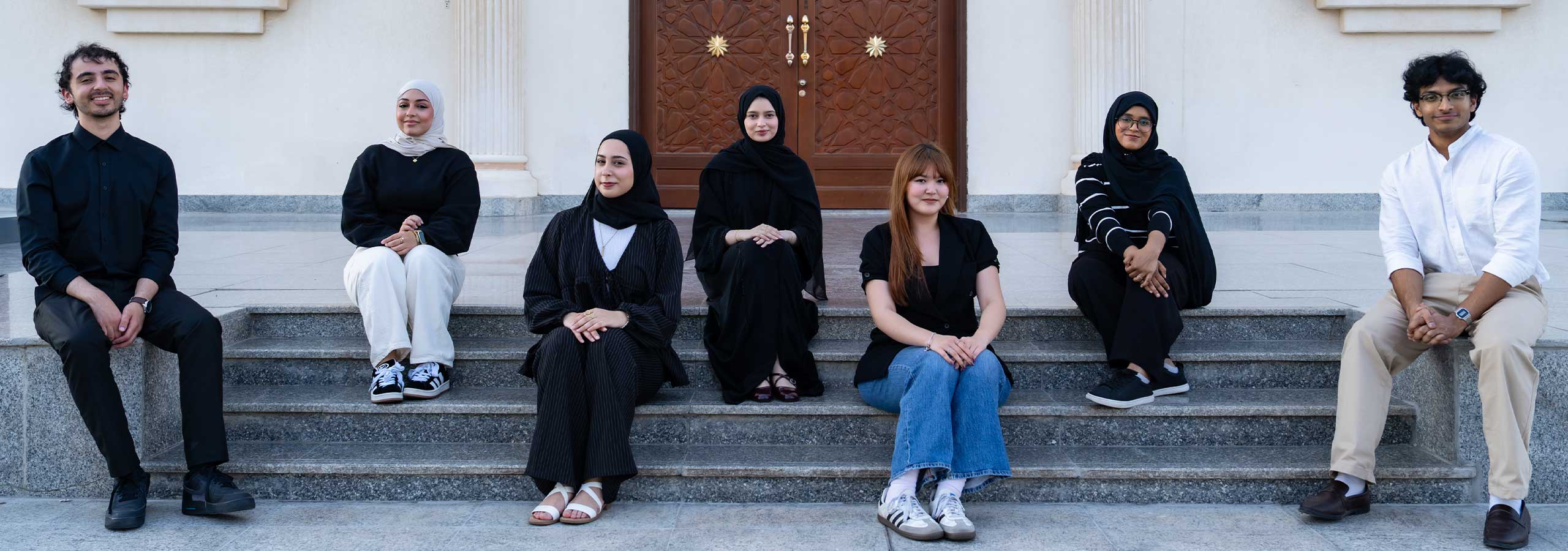
- Fahimah Saiyed
Fahimah Saiyed believes that research rarely follows a straight path. She enjoys research for the opportunity it gives her to ask questions and to keep learning. She hopes to give other students the chance to explore research for themselves and discover the curiosity, creativity and enjoyment that can come from the process. Her research interests lie in understanding how social and cultural worlds shape psychological experiences.
Editor-in-Chief
[email protected]
Bachelor of Arts in Psychology- Karim Tamim
Throughout his academic years, Karim Tamim has come to realize that the only true limitation to increasing one’s competence depends on the accessibility of knowledge. He is dedicated to ensuring that students’ thoughts and ideas do not go unnoticed and are shared with the public. His research interests include exploring morality through the lenses of neuropsychology and cultural psychology.
Student Associate Editor
[email protected]
Bachelor of Arts in Psychology with a Minor in Philosophy- Earielle Capili
“Curiosity killed the cat, but satisfaction brought it back.” Earielle Capili believes that we often accept what we know as truth, forgetting that even the obvious can have deeper meanings—just like the proverb. Driven by curiosity, she wants to challenge what she already knows and encourage others to do the same. Her research interests include cultural and social psychology.
Ethics Editor
[email protected]
Bachelor of Arts in Psychology with a Minor in Arabic Language and Literature- Asmaa Itani
Asmaa Itani looks beyond the surface of what we initially think and see, bringing a creative eye to her work. She is excited to contribute to a platform that brings forward hidden perspectives and opinions. Her research interests, though less scientific, often overlap with those in the field of psychology and include user-centered design, identity and culture.
Design Lead
[email protected]
Bachelor of Science in Design Management with a Minor in Marketing- Tala Ghazzawi
Tala Ghazzawi is always looking for new ways to expand her experience and explore how design can connect with different fields. She is especially interested in visual storytelling, communication and creating experiences that shape how identity can be expressed through creative work. Being part of this platform allows her to contribute her own creative perspective while learning from a field that approaches people and behavior in a completely different way.
Co-Designer
[email protected]
Bachelor of Science in Design Management- Vismay Nair
Vismay Nair has always been passionate about asking questions and was excited by the opportunity to help fellow students bring their own questions and research to a wider audience. His research interests include educational, organizational and social psychology.
Reviewer
[email protected]
Bachelor of Arts in Psychology with a Minor in Data Science- Fadwa Kareem
Fadwa Kareem’s background as a research assistant and lifelong interest in psychology led her to the behind-the-scenes work of operating a research journal. As a reviewer, she is honored to have a direct influence on the publication process. Her research interests include organizational and forensic psychology.
Reviewer
[email protected]
Bachelor of Arts in Psychology- Dr. Lucy Tawidian
Dr. Lucy Tawidian
Faculty Advisor and Assistant Professor in Psychology
[email protected]- Dr. Christopher Bryan
Dr. Christopher Bryan
Faculty Advisor and Assistant Professor in Psychology
[email protected]
Author Guidelines
Nafs welcomes scholarly work produced by AUS undergraduate students, including:
Eligibility and Submission Requirements
For course papers, a proposed minimum eligibility threshold of B+ would allow a paper to be considered for submission to the journal. Meeting this threshold indicates eligibility for consideration but does not in itself imply that the manuscript is suitable for publication. All eligible manuscripts will undergo the journal’s standard editorial screening and peer-review process.
Authors should submit:
Anonymized Manuscript
Main text formatted in APA 7th edition. Do not exceed 6,000 words with a 250-word abstract.
Title Page
Including author details, affiliations, funding statements and Institutional Review Board declarations. (Use the template in Appendix A of the Nafs Student Handbook).
Signed Author Agreement Form
Confirming originality and copyright compliance. (Complete the form in Appendix B of the Nafs Student Handbook)
AI Usage Declaration
Required prior to references if generative AI tools were used for editing or formatting. (See Appendix C of the Nafs Student Handbook for the template and Section 4 for permitted/prohibited uses)
Grade Proof
Screenshot verifying a B+ minimum grade (for coursework papers)
Download the Nafs Student Handbook (PDF).
Manuscripts will be screened for eligibility, completeness, formatting, scope and any obvious ethical or research-integrity concerns before proceeding to peer review.
Submissions first undergo editorial screening before proceeding to anonymized peer review, normally by two reviewers. Authors may be asked to revise their manuscripts in response to reviewer and editorial feedback.
For step-by-step details on reviewer decisions, revision rules, Institutional Review Board pathways and publication, refer to the Nafs Student Handbook.
Submissions should be emailed to [email protected] by 4 p.m. on the last day of classes of Week 12 of Fall 2026.
Nafs is published once annually, with the possibility of additional special issues dedicated to broad topics of interest within psychology. Calls for papers for special issues will be announced as applicable, along with relevant submission guidelines and deadlines.
Policies, Ethics and Copyright
Nafs is committed to maintaining high standards of academic integrity, research ethics, responsible authorship and scholarly publishing. All submissions must comply with applicable AUS policies and requirements.
- Research Ethics and Institutional Review Board
Nafs follows an established pathway developed in consultation with the AUS Institutional Review Board (IRB) for manuscripts involving human-participant research.
Empirical studies originally conducted for pedagogical purposes may undergo retrospective IRB review, provided that the research data have been appropriately anonymized. Manuscripts will be referred for review only after they have progressed through the journal’s initial editorial and peer-review process.
Non-empirical submissions, including literature reviews, research proposals and other papers that do not involve the collection or analysis of human-participant data, do not normally require IRB review. A submission may be referred to the IRB if the Faculty Advisors identify a potential ethical or institutional concern.
The Faculty Advisors oversee this process and identify manuscripts requiring IRB consideration. No manuscript requiring IRB review will proceed to publication until the relevant review has been completed. Editorial acceptance does not override ethical requirements.
Nafs follows AUS requirements concerning originality, academic integrity, authorship, conflicts of interest, and ethical research and publication practices.
Authorship is reserved for individuals who have made substantive contributions to the work, approved the final manuscript and accept responsibility for its content. Supervisory or advisory status alone does not automatically qualify a faculty member or other contributor for authorship.
Authors are responsible for ensuring that their submissions are original and that sources, contributions and other forms of assistance are appropriately acknowledged.
- Responsible Use of Artificial Intelligence
The use of artificial intelligence (AI) tools must comply with current AUS academic-integrity requirements for undergraduate students. Limited technical assistance, such as linguistic refinement, structural planning and bibliographic or formatting support, may be permitted where consistent with these requirements.
AI tools may not be listed as authors. Authors must not present undisclosed substantive AI-generated content as their own work or outsource interpretation or analysis to AI tools without appropriate disclosure. Authors remain responsible for the accuracy, originality, interpretation and analysis of their submissions.
Where applicable, AI use must be disclosed transparently in accordance with current AUS requirements. Authors should also protect the confidentiality of unpublished work and should not upload submitted manuscripts to public AI systems for review or summarization.
View AI usage and disclosure guidelines in the Nafs Student Handbook (PDF).
- Copyright and Publication Rights
Following publication, accepted manuscripts are deposited in the AUS Library repository, where a repository record and DOI are created.
Copyright and licensing arrangements will follow applicable policies under the Creative Commons Attribution-NonCommercial-NoDerivatives 4.0 International License (CC BY-NC-ND 4.0), which the journal publishes under This license allows others to share published articles with appropriate attribution for non-commercial purposes, provided that the work is not modified or adapted.
For detailed information about copyright, licensing, and the rights of authors and users, please refer to the Author Agreement Form (Appendix B) in the Nafs Student Handbook.
Contact
Email | [email protected]