Latest News
October 15, 2026
October 13, 2026
October 13, 2026

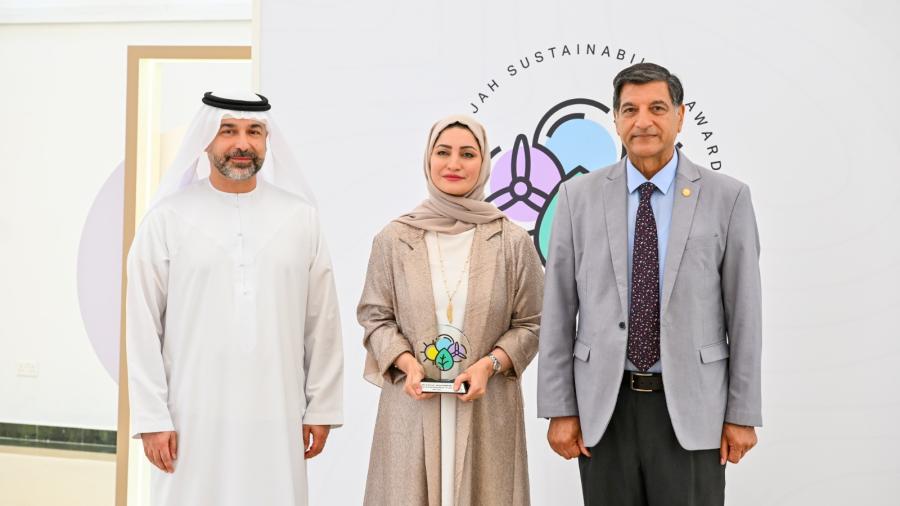
Photo caption: Dr. Israa al Khafaf with Dr. Fadi Aloul, Dean CEN and project mentor Dr. Adil Tamimi
At the 14th cycle of the Sharjah Sustainability Award (SSA) ceremony held on June 11, 2026, American University of Sharjah (AUS) alumna Dr. Israa Al Khafaf won first position in the Research & Innovation category. Following a highly selective evaluation process overseen by an independent panel of expert judges, Dr. Al Khafaf and the College of Engineering (CEN) faculty team emerged triumphant.
Organized by the Environment and Protected Areas Authority (EPAA) in Sharjah, the annual SSA program stands as one of the region's most competitive platforms for environmental innovation, attracting more than 180 submissions from universities across the nation.
Dr. Al Khafaf, a graduate of the PhD in Engineering - Engineering Systems Management program at AUS, secured the award for her doctoral dissertation “Decision Support Tool (DST) for Optimizing Carbon Sequestration of Desert Urban Vegetation: A Sharjah Case Study.” Developed under the collaborative guidance of her research advisors, Dr. Adil Tamimi, Professor of Civil Engineering at AUS, and her co-advisor, H.E. Dr. Abdullah Belhaif Al Nuaimi, former Minister of Climate Change and Environment, the project is a predictive model designed to calculate the potential carbon sequestration of urban green spaces. It utilizes a tree-ranking index to identify optimal green space designs and determines which UAE-specific tree species are most effective at atmospheric carbon dioxide removal within the local climate.
"Winning the award means my research is being recognized, and with that recognition comes real, tangible implementation," Dr. Al Khafaf said. "This tool is designed to change how desert cities think about their green spaces and turn neglected land into a genuine climate contribution tool. Beyond the science, what matters most is the impact on people, greener neighborhoods, cooler streets and cleaner air. Improving lives and protecting the environment has always been the true intention behind this work, and this award brings that goal one step closer.”
The inspiration behind the scientific work is deeply rooted in the local landscape.
"My primary inspiration has always been the guiding words of His Highness Sheikh Dr. Sultan bin Mohammed Al Qasimi, UAE Supreme Council Member and Ruler of Sharjah," Dr. Al Khafaf emphasized. "His Highness’s public encouragement highlighting the benefits of trees in sequestering carbon and harmful gases, alongside his direct calls for residents to plant trees, served as the foundational spark for this entire work. Hearing a leader articulate carbon absorption at a household level drove me to build a system that provides scientific proof of his vision, scaling it directly into regional municipal policy."
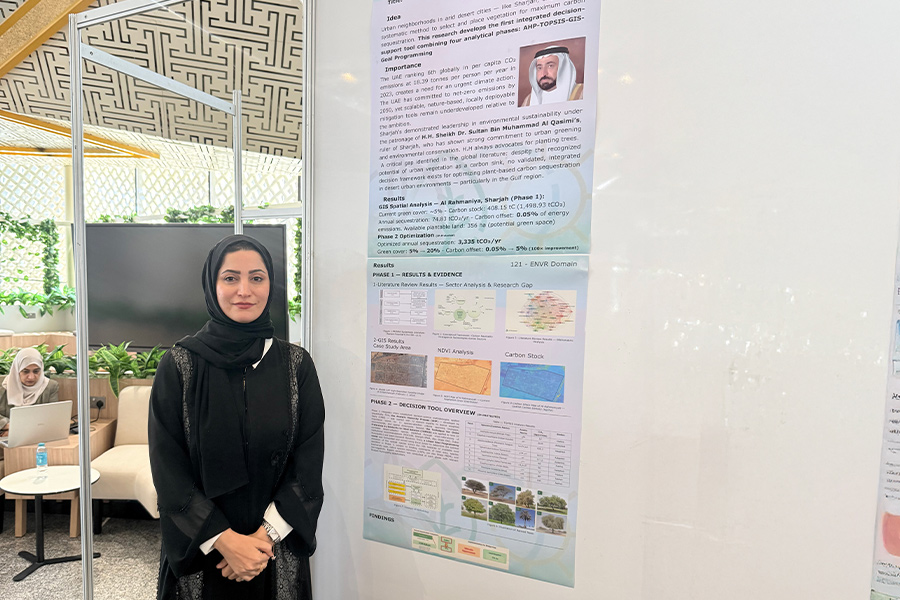
Photo caption: Dr. Israa al Khafaf with her presentation at the SSA
Dr. Al Khafaf developed the model by conducting a GIS analysis of Sharjah's Al Rahmaniya suburb using the Khalifa SAT-1 multispectral imaging data from the Mohammed Bin Rashid Space Centre. The framework considered factors such as carbon capture capacity, water needs, costs and local climate suitability to optimize urban planting. Findings revealed a significant environmental gap, with existing vegetation covering only 5 percent of available green space and offsetting just 0.05 percent of local energy emissions. These results and the tool's criteria were validated by a panel of experts from various UAE municipal and sustainability sectors, including Sharjah Municipality, the EPAA, Sharjah Sustainable City and Dubai Municipality.
The highlight of this rigorous engineering journey came when the quantitative models gave implementable results.
Dr. Al Khafaf explained that the project's turning point occurred when data demonstrated that strategic tree planting could increase a single Sharjah neighborhood's carbon offset from 0.05 percent to 5 percent of local energy emissions. This 100-fold improvement in carbon neutrality is achievable without new technology, additional land, or major capital investment, simply by optimizing which trees are planted and their specific locations.
By deploying prioritized species across optimized tree positions within the existing Al Rahmaniya land inventory, the tool demonstrates how cities can systematically support the UAE Net Zero 2050 Strategy.
"Dr. Al Khafaf’s victory among such an elite field of national research submissions highlights the collaborative research ecosystem fostered at AUS," stated Dr. Adil Tamimi. "Her satellite-driven analysis effectively transitions theoretical modeling into civil implementation. It shows how our engineering curricula equips scholars with the tools, resources and strategic support necessary to architect practical, high-impact solutions for achieving the nation's climate neutrality objectives."
Looking ahead, Dr. Al Khafaf plans to secure institutional partners and investors to translate her research model into a formal consultancy framework capable of advising public planning departments and municipal ministries on data-driven tree planting strategy.
The win adds to a highly decorated legacy of success for the university at the SSA. AUS researchers, students and the AUS campus have consistently won across multiple categories over successive cycles. This includes top projects tackling hazardous "forever chemicals", student-engineered marine oil filtration prototypes, desalination waste solutions, and the university winning the prestigious Outstanding Campus Award at the 7th edition of the ceremony.
American University of Sharjah remains committed to be a regional pioneer in green innovation, currently holding the top rank in the UAE, and is placed among the top 150 globally for environmental sustainability according to the QS World University Rankings. This commitment is a key theme of the 2025–2030 Strategic Plan and is embedded in the curriculum, where 70 percent of graduates have completed at least one course with sustainability-focused learning outcomes and 72 percent of academic departments offer sustainability courses.
About the EPAA and the SSA
The Environment and Protected Areas Authority (EPAA) in Sharjah is a regulatory government entity established to protect the environment, preserve biodiversity and raise environmental awareness across the emirate. Operating under the vision of His Highness Sheikh Dr. Sultan bin Mohammed Al Qasimi, Supreme Council Member and Ruler of Sharjah, the authority manages a vast network of nature reserves and breeding centers for endangered wildlife.
The Sharjah Sustainability Award (SSA) is an annual initiative by the EPAA designed to promote environmental innovation and sustainable practices. It encourages students and researchers to create practical, scalable solutions for climate and ecological issues. Supporting the UAE's national sustainability objectives, the SSA assesses entries on their originality, resource management and real-world utility.

By continuing, you will be taken to a website not affiliated with American University of Sharjah. Links to external sites are provided only for users' convenience and imply no endorsement of the site and/or its content. Note that the privacy policy and security settings of the linked site may differ from those of the AUS website.