Latest News
October 12, 2026
October 1, 2026
September 30, 2026
September 29, 2026

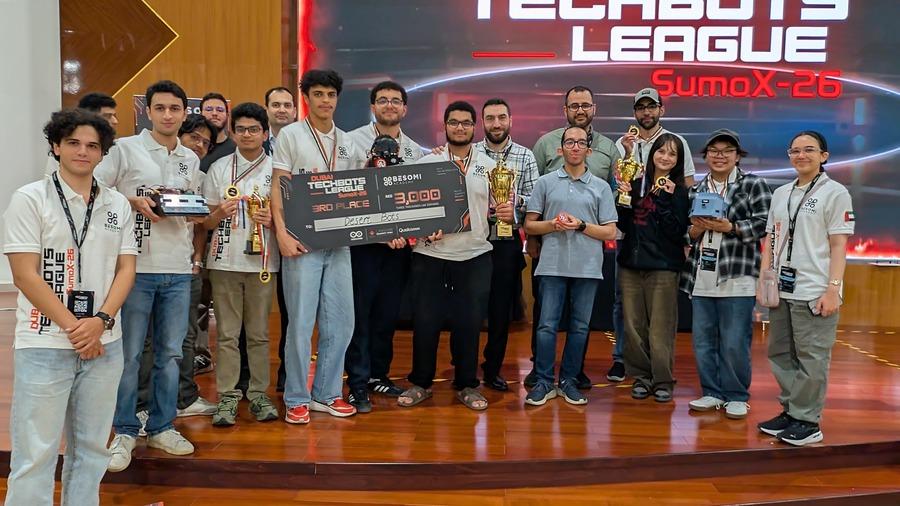
Every robot at the Dubai Techbots League SumoX-26 had the same task: push its opponent out of the arena. American University of Sharjah (AUS) students found different ways for their robots to do it, earning third place and awards for mechanical design, strategy and teamwork.
Held recently at Canadian University Dubai and organized by Arduino, Qualcomm and Besomi, the competition brought together 64 university teams from across the UAE, including 13 from AUS. Students built robots that operated without remote control, weighing no more than 3 kg and with bases measuring no more than 20 × 20 cm. Besomi supplied the required Arduino Uno Q boards used to program and control the robots free of charge and provided training before the event.
For Desert Bots members Yahya Mashaly, Maged Mohammad and Hazem Sherif, third place and an AED 3,000 prize followed weeks of building, testing and refining their robot. Mashaly studies in the Bachelor of Science in Intelligent Systems and Mechatronics Engineering program, while Mohammad and Sherif are Bachelor of Science in Mechanical Engineering students.
The team handled every stage of development, from selecting components and 3D printing to assembly, wiring and programming. They worked through failed prints, revised their designs and learned to solder electrical connections along the way.
“There is a big difference between having a design that looks right and having a robot that works,” said Mashaly. “Building it ourselves helped us understand that.”
Their preparation was tested during the semifinal when the programming board failed and an electrical connector broke during repairs, leaving just two minutes to attempt a fix. Although they lost the match, they repaired the robot and returned to secure third place.
“Everyone knew the robot well because we had worked on it together,” said Mohammad. “That helped us find the problem and get it running again.”
“Coming back and taking third place was a proud moment for all three of us,” added Sherif.
Team Hiro’s Zirel Manguiat, Abdullah Muhammad and Kasih Khairi, all Bachelor of Science in Mechanical Engineering students, earned the Best Mechanical Design Award. Their robot featured a custom 3D-printed frame, powerful motors and sensors to detect and track opponents. When the frame was damaged days before the competition, they printed a replacement and rebuilt the robot in four hours, drawing on AUS manufacturing facilities, faculty and lab instructors, and the Makerspace, a workshop for building and testing projects.
Team RQ-Louts Punch earned the Best Strategy Award by prioritizing strength and stability over speed. Fatima Almarzooqi, a Bachelor of Science in Electrical Engineering student, and Maha Alsarkal, a Bachelor of Science in Computer Engineering student, teamed up with University of Sharjah physics student Ghalya Ahmed Alblooshi. They selected motors with larger gearboxes to provide the pushing power needed to resist and counter opponents’ pushes.
Sponsored by Rubu’ Qarn Science and Technology and supported by an external supervisor, the team also received guidance from the AUS Department of Computer Science and Engineering and Department of Electrical Engineering, alongside access to the Makerspace through the Department of Mechanical Engineering.
Big Chungus members Mohammed Al Khayat, Md. Neamul Chowdhury and Abdulkadar Awad Aslam received the Best Teamwork Award. Their four-wheel robot used a separate motor for each wheel, with a lightweight 3D-printed plastic base and foam board to stay within the weight limit.
To fit the motors into the limited space, they connected some directly to the wheels and others through a toothed belt and pulleys. The team coordinated the robot’s mechanical, electrical and software systems throughout the build.
AUS faculty, lab instructors and teaching assistants supported the teams throughout their preparations. Dr. Bara Emran and Dr. Ammar Hassan from the Department of Electrical Engineering, along with Engineer Wasim Almasri from the Department of Mechanical Engineering, attended the competition to encourage the students.
“Building and testing their robots gave students a deeper understanding of how their decisions affect performance,” said Dr. Mamoun Abdel-Hafez, Head of the AUS Department of Mechanical Engineering. “It was rewarding to see them use that understanding to improve their designs and earn recognition for their work.”
Dr. Fadi Aloul, Dean of the AUS College of Engineering, said opportunities to take a project from an idea to a working machine are an important part of students’ education.
“We give students room to build, experiment and take ownership of their work,” he said. “They learn to properly communicate their ideas and decisions, work with their multidisciplinary teammates and solve real-world problems that do not come with a ready answer. Those habits will serve them well when they leave university and begin working on projects where other people depend on their judgment.”
The AUS College of Engineering combines laboratory work, design projects and internships with faculty guidance and facilities such as the Makerspace, helping students test ideas, work across disciplines and prepare for engineering careers.
For more information about the AUS College of Engineering, visit www.aus.edu/cen.

By continuing, you will be taken to a website not affiliated with American University of Sharjah. Links to external sites are provided only for users' convenience and imply no endorsement of the site and/or its content. Note that the privacy policy and security settings of the linked site may differ from those of the AUS website.