Latest News
November 19, 2026
November 19, 2026
November 18, 2026
November 18, 2026

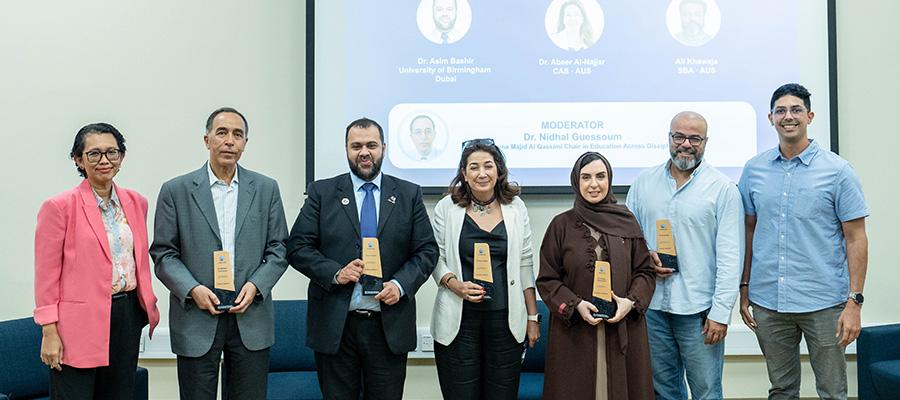
As artificial intelligence is reshaping the classroom and global labor markets, American University of Sharjah’s (AUS) AI Week Fall 2026 program brought together more than 120 participants, including faculty members, students, researchers, staff and industry experts. The university-wide event, organized by the Center for Innovation in Teaching and Learning (CITL), featured keynotes, panel discussions, technical workshops and research showcases designed to strengthen AI literacy, refine assessment models and foster cross-disciplinary collaboration.
Held from November 2 to 5, AI Week Fall 2026 built on the success of the January edition of the event. These programs align closely with national priorities, including the , which seeks to integrate advanced technologies across key sectors to build a knowledge-based economy. By encouraging critical discourse on responsible AI research and deployment, AUS continues to support the country's vision as a regional hub for innovation and technological excellence.
The primary strategic objectives for AI Week Fall 2026 were centered on advancing practical and responsible AI use across the fields of teaching, learning and research, while connecting the campus community directly with industry experts. Throughout the event, there was a marked shift from general awareness to focused inquiries regarding implementation, assessment methods, ethical boundaries and institutional readiness.
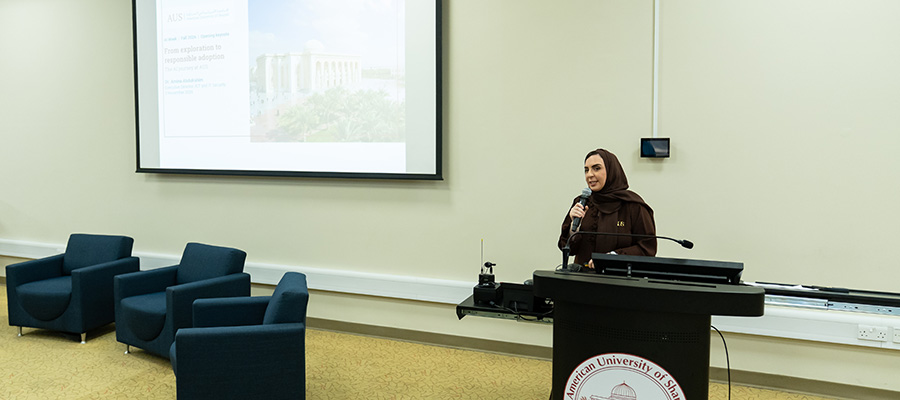
With the opening day focused on governance, cybersecurity and pedagogical integration, Dr. Amina Abdulrahim, Executive Director of ICT and IT Security at AUS, delivered the opening keynote, highlighting the importance of robust digital infrastructure and institutional readiness as universities adapt to rapid technological shifts.
“As artificial intelligence becomes increasingly embedded in our daily academic and operational landscapes, establishing robust security frameworks and clear guidelines is essential,” noted Dr. Abdulrahim.
Her address was followed by a panel discussion titled “Assessment in the Age of AI,” moderated by Dr. Nidhal Guessoum, Professor of Physics and the Sheikha Nama Majid Al Qassimi Chair in Education Across Disciplines. Panelists included Dr. Asim Bashir, Teaching Fellow in English for Academic Purposes and Assessment Coordinator at the University of Birmingham Dubai; Dr. Abeer Al-Najjar, Professor of Media Communication at AUS; and Ali Khawaja, Senior Instructor in the Department of Management, Strategy and Entrepreneurship at AUS. The discussion centered around strategies for redesigning traditional evaluation models to test critical thinking and comprehension in an environment where AI tools are readily accessible.
The second day shifted toward industry applications, locally relevant solutions, practical workflows and industry norms. Dr. Jihan Zahran, Chief AI and External Affairs Officer at Gulf Data International, delivered a hands-on workshop on linking AI adoption to measurable business value and highlighted the strategic importance of developing locally trained models. Concurrently, Microsoft specialists Rane Moodley, Modern Work Solution Area Specialist for Middle East and Africa, and Siddharth Dabrai, AI Business Solutions Specialist, led a hands-on workshop titled “From AI User to AI Creator: Unlocking the Power of Copilot and AI Agents,” equipping attendees with practical techniques to utilize Copilot for productivity.
Research and classroom innovations took center stage on the third day. Dr. Umit Cali, Professor of Electrical Engineering and Founding Director of the AI, Robotics and Connected Infrastructure (ARC) Research Center at AUS, delivered the research keynote on interdisciplinary applications bridging AI with smart infrastructure. Additional faculty presentations showcased practical classroom implementations, including Diana Audi, Senior Instructor of Mathematics and Statistics, and Dr. Pekka Olavi Santtila, Professor of Psychology. The session concluded with a showcase of innovative faculty projects developed by the AI Teaching Bootcamp winners: Dr. Abdallah Ghazal, Dr. Hussam Alshraideh and Dr. Abdurrahman Irscheid from the AUS College of Engineering. The AI Teaching Bootcamp is a practical professional learning experience designed to help faculty use generative AI purposefully, critically and responsibly in their teaching.
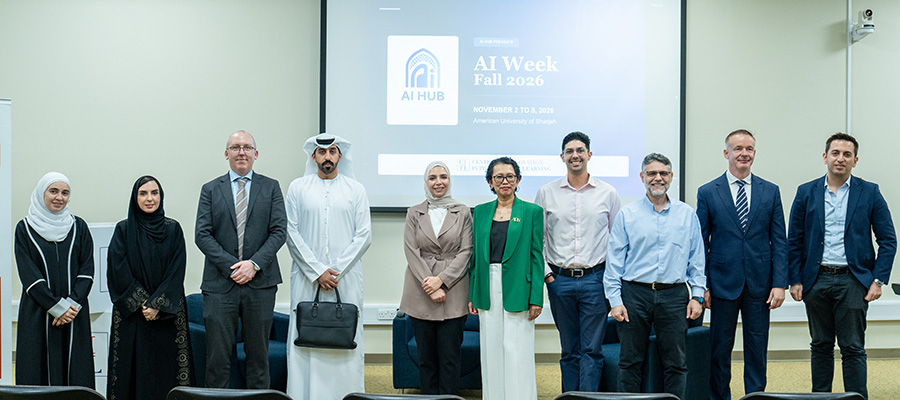
The closing day of AI Week examined workforce adaptability to AI and the changing demands of the global labor market. Dr. Norita Ahmad, Director of CITL and Professor of Information Systems and Business Analytics, moderated the closing industry panel, “Preparing Students for a Changing World,” featuring insights from industry leaders including Farah Daabas, Account Manager at TikTok; and Hashim Alsharif Alzaabi, Director of Strategy, Transformation and Implementation at EY.
"Preparing our students for the future requires a collaborative dialogue between academia and industry," stated Dr. Ahmad. "Through initiatives like AI Week, we bridge theoretical knowledge with practical expectations, ensuring our graduates enter the workforce equipped with both digital fluency and the critical problem-solving skills demanded by a rapidly changing global economy."
The event concluded with closing remarks from Dr. James Griffin, Vice Provost for Undergraduate Affairs and Instruction, who reaffirmed AUS' commitment to maintaining high academic standards while empowering students and faculty to engage responsibly and creatively with emerging technologies.
Upcoming CITL AI initiatives will focus on continued faculty development, hands-on workshops, support for classroom pilot projects and expanded sharing of AI teaching practices. It will also include further refinement of institutional guidance for responsible AI usage to inform future programming for the AI Hub, a CITL initiative that serves as a practical home for the AUS community to engage with artificial intelligence in teaching, learning and research.
To learn more about the AUS AI Hub, visit aihub.aus.edu.
To learn more about CITL, visit www.aus.edu/academics/services-and-resources/center-for-innovation-in-te....
By continuing, you will be taken to a website not affiliated with American University of Sharjah. Links to external sites are provided only for users' convenience and imply no endorsement of the site and/or its content. Note that the privacy policy and security settings of the linked site may differ from those of the AUS website.