Latest News
November 23, 2026
November 19, 2026
November 19, 2026
November 18, 2026

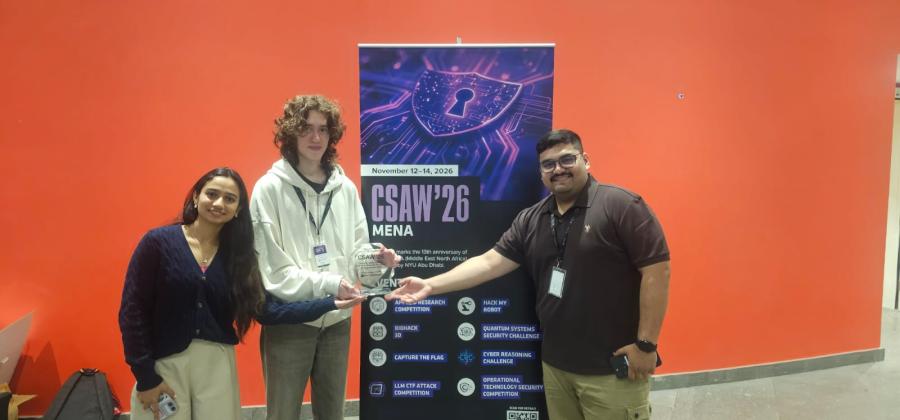
Three students from American University of Sharjah (AUS) set out to see how AI agents could work together to solve cybersecurity challenges. Their system, Antihydra, coordinated multiple agents to explore possible solutions, use cybersecurity tools and share useful discoveries. The team, AUSEC, earned second place in the Large Language Model Capture the Flag Attack Competition at Cyber Security Awareness Week (CSAW) 2026 MENA, held at New York University Abu Dhabi.
The competition examines how large language models can solve cybersecurity Capture the Flag challenges. Teams were challenged to use AI systems to identify vulnerabilities and recover hidden answers, known as “flags,” in puzzles involving web security, cryptography, digital forensics, reverse engineering and binary exploitation. They also had to document how their systems reached their answers and explain their approach in a final presentation. Judges assessed the number of challenges solved, the creativity and efficiency of each approach and the quality of the presentation.
AUSEC team members are Sarah Mulla, a junior in the Bachelor of Science in Computer Engineering program; Alikhan Sirgaliyev, a sophomore in the Bachelor of Science in Computer Science program; and Alizar Farhan, a Master of Science in Computer Engineering student. Each contributed a key idea to Antihydra, which the team designed to investigate and test solutions autonomously, without human intervention during the solving process.
“We wanted to build a system that could keep working through a challenge, exploring possibilities and learning from what it found,” said Mulla. “Antihydra let us bring those ideas together in a way that could investigate a problem without requiring someone to guide each step.”
Antihydra’s agents could investigate the same challenge simultaneously, use cybersecurity tools and share useful findings. An overseer monitored their progress, automated checks verified recovered flags and logs recorded the investigation process.
“Having several agents explore a challenge at once gave the system more ways to approach it,” said Sirgaliyev. “The agents could share useful discoveries, while the overseer helped keep the investigation on track and the checks confirmed whether an answer was correct.”
Across its recorded runs, Antihydra solved 21 distinct challenges. In the final complete evaluation, it solved 15 out of 23 challenges in approximately 90 minutes. The team also focused on affordability: by combining several open-weight lower-cost models with coordinated execution and supervision, it kept model costs below US $0.6 per task
“For us, performance also meant being thoughtful about the resources we used,” said Farhan. “We wanted to see what a carefully designed system could achieve with a modest budget, as well as how it could solve the challenges.”
AUSEC’s achievement highlights the hands-on problem-solving fostered at the AUS College of Engineering. By designing and testing Antihydra, the students applied their engineering knowledge to a complex challenge at the intersection of AI and cybersecurity. Their work reflects the college’s commitment to preparing students to develop practical solutions for emerging technological challenges. Learn more about the AUS College of Engineering.
By continuing, you will be taken to a website not affiliated with American University of Sharjah. Links to external sites are provided only for users' convenience and imply no endorsement of the site and/or its content. Note that the privacy policy and security settings of the linked site may differ from those of the AUS website.