Latest News
October 15, 2026
October 13, 2026
October 13, 2026

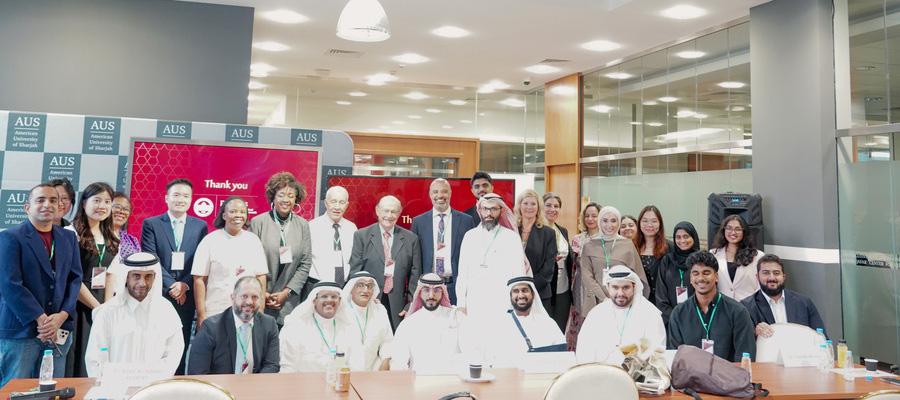
The School of Business Administration (SBA) at American University of Sharjah (AUS) hosted the 65th World Continuous Audit and Reporting Symposium (WCARS) under the theme “Everything Is AI Now,” bringing together leading international academics, practitioners and policy makers to examine how artificial intelligence (AI) is transforming auditing, financial reporting and assurance.
“AI is changing the very foundations of how we record, analyze and trust financial information. By bringing WCARS to Sharjah, we have created a platform where global pioneers in continuous auditing can meet regional regulators, firms and students to explore this change together,” said Dr. Narjess Boubakri, Dean of SBA. “This symposium strengthens our role as a hub for rigorous, practice-oriented research and ensures that what we teach in our classrooms, and what we study in our labs, speaks directly to the future needs of the accounting profession in the UAE and beyond.”
Throughout the day, research and practitioner sessions explored AI from multiple angles. Presenters examined large-scale data capture and real-time analytics in the age of AI; national AI initiatives in the UAE and their implications for public finance and control; the use of AI and blockchain in the environmental, social and governance framework, and sustainability reporting; predictive analytics and machine learning for audit risk assessment and fraud detection; and digital, privacy-preserving workflows for receivable confirmations. Conceptual frameworks for AI-powered continuous auditing in government resource systems were also discussed, highlighting both the opportunities AI offers for enhanced transparency and the governance and ethical questions it raises.
The symposium featured keynote addresses by Professor Miklos Vasarhelyi, KPMG Distinguished Professor and Director of the Rutgers Accounting Research Center and Continuous Auditing and Reporting Laboratory; Dr. Yvonne Hinson, Chief Executive Officer of the American Accounting Association; and Dr. Helen Brown-Liburd, Associate Director of the CAR Lab, Associate Professor at Rutgers University and member of the PCAOB Data and Technology Task Force. Drawing on decades of work at the intersection of technology and assurance, they discussed how AI-driven continuous auditing, advanced analytics and generative models are reshaping audit evidence, risk assessment and regulatory expectations, and outlined the capabilities organizations and auditors must build to remain ahead of these developments.
A central feature of WCARS was the panel discussion “The Future of Accounting in the Age of AI,” moderated by Dr. Feras M. Salama, Professor of Accounting at AUS. The panel brought together AUS faculty members Dr. Ashraf Khallaf, Professor of Accounting, and Dr. Kimberley Gleason, Professor of Finance, with senior industry leaders Mohamed AlMheiri, Chief Audit Executive at Emarat – Emirates General Petroleum Corporation, and Khalid Al Hammadi, Head of Internal Audit at Dubai Taxi Company PJSC. The discussion focused on how AI is reshaping internal audit functions, skills and governance structures, addressing practical issues such as integrating AI into existing assurance processes, managing data quality, balancing automation with professional judgment and aligning AI adoption with the UAE’s broader digital transformation agenda.
As symposium co-chair, Dr. Eid Alotaibi, Assistant Professor in the Department of Accounting and Information Systems at AUS, underlined the link between global research and regional practice.
“Throughout WCARS we saw concrete examples of how AI is already embedded in audit work—whether in continuous transaction monitoring, ESG assurance or government resource systems—rather than being a distant promise. Hosting this symposium at AUS gives our students, faculty and partners direct access to these innovations and allows us to contribute evidence-based insights from the region to a long-running global conversation on technology and assurance,” he said.
The event concluded with the presentation of the Best Paper and Best Presentation Awards, recognizing outstanding contributions that advanced understanding of AI’s role in auditing and reporting. Selected papers from the symposium will be considered for publication in a special section of the Journal of Emerging Technologies in Accounting, extending the impact of WCARS beyond the event.
The symposium was organized in collaboration with the Rutgers Accounting Research Center and its Continuous Auditing and Reporting Laboratory, and held in association with the Journal of Emerging Technologies in Accounting of the American Accounting Association.
AUS is ranked number one (tied) in the UAE and among the top 250 universities globally for accounting and finance (QS World University Rankings 2025). Through its Bachelor of Science in Business Administration majors in Accounting and in Information Systems and Business Analytics, the Master of Business Data Analytics, the Master of Science in Accounting and a Minor in Accounting, SBA equips graduates with the technical, analytical and ethical foundations they need to lead the profession in an AI-driven business world.
Click here to learn more about SBA offerings.
By continuing, you will be taken to a website not affiliated with American University of Sharjah. Links to external sites are provided only for users' convenience and imply no endorsement of the site and/or its content. Note that the privacy policy and security settings of the linked site may differ from those of the AUS website.