Latest News
October 22, 2026
October 21, 2026
October 20, 2026

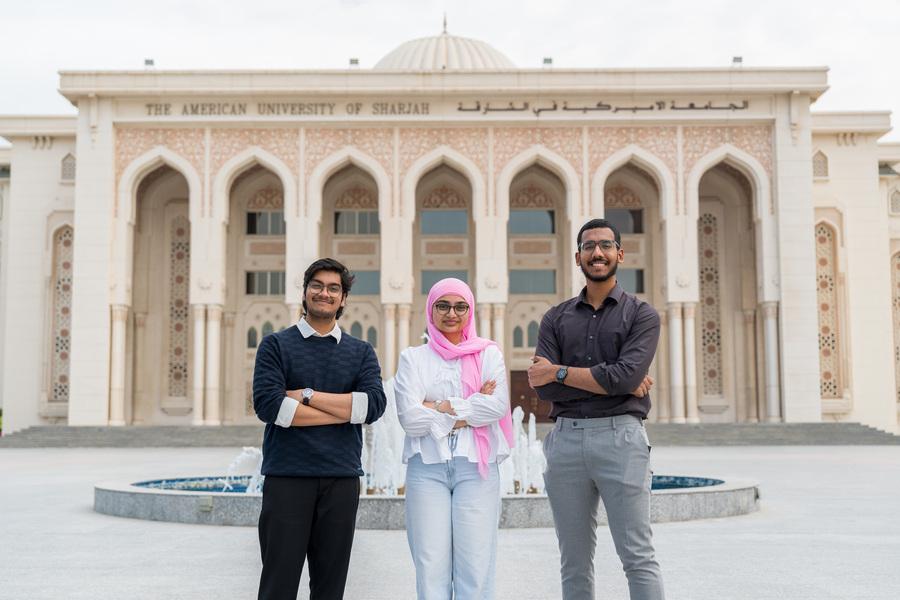
At a time when cities around the world are searching for smarter and more sustainable infrastructure, three students from American University of Sharjah (AUS) have shown how engineering can offer practical answers. A student team from AUS secured first place at the 2026 World Engineering Day Hackathon, an international competition that brings together engineering students and young professionals from across the globe to develop solutions aligned with the United Nations Sustainable Development Goals.
Organized by the World Federation of Engineering Organizations as part of the global celebration of World Engineering Day for Sustainable Development, an International Day proclaimed by UNESCO, the hackathon is one of the world’s largest international competitions for engineering students. It brings together participants from different disciplines to develop innovative solutions to real-world challenges aligned with the United Nations Sustainable Development Goals. The 2026 edition focused on SDG 9: Industry, Innovation and Infrastructure, inviting teams to propose ideas that strengthen resilient infrastructure, advance sustainable industrialization and accelerate technological innovation. Marking the fifth edition of the hackathon, this year’s competition also represented a significant milestone for the region, with AUS becoming the first team from the Arab world to win first place.
Commenting on the achievement, Dr. Fadi Aloul, Dean of the AUS College of Engineering, noted that the win reflects the strength of AUS’ engineering ecosystem and the university’s ability to prepare students to lead with innovation in addressing global sustainability challenges.
“Winning first place in a global competition of this caliber reflects the strength of AUS as a hub for engineering education, innovation and applied research,” he said. “It demonstrates our ability to prepare students not only to excel academically, but to contribute solutions to the complex challenges shaping communities and industries worldwide. This achievement is especially significant as AUS has also been named an official partner for World Engineering Day for Sustainable Development 2026, reinforcing our role in advancing engineering education that is globally engaged, future-focused and closely aligned with sustainable development priorities.”
Against a competitive international field of more than 3,000 registrations and 270 submissions, the AUS team distinguished itself with a solution that combined innovation with practical relevance.
Representing AUS, Team THINK³—composed of team leader Mohamed Umar Sahul Hameed, a computer science student, Laiba Maqbool, an electrical engineering student, and Ayush Agrawal, a computer engineering student—earned the top prize for their project Smart Adaptive Streetlight System, a concept designed to improve energy resilience in cities facing extreme heat.
Their solution reimagines conventional streetlights as intelligent renewable energy infrastructure. Each unit integrates solar panels, a small vertical-axis wind turbine, local energy storage and sensors that monitor temperature, light levels and movement. Using artificial intelligence, the system dynamically adjusts lighting levels in response to real-time activity, dimming when streets are empty and brightening when vehicles or pedestrians are detected. During the day, the streetlights generate and store renewable energy that can later be released during peak evening demand, helping support nearby microgrids and reduce strain on the main power grid during heatwaves.
“For cities in hot climates like the UAE, energy demand rises dramatically during extreme heat,” said Umar. “We wanted to explore how everyday infrastructure such as streetlights could become part of the solution by generating and sharing renewable energy while still serving their primary purpose. The idea was to turn something familiar into something more useful for the city.”
The project reflects the growing role of engineering students in tackling global sustainability challenges. By combining renewable energy systems, sensor technologies and artificial intelligence, the team proposed a decentralized energy approach that could help cities build more resilient urban systems.
Maqbool emphasized that the team’s collaboration played a central role in shaping the concept.
“THINK³ reflects the idea that when three people think together, the outcome becomes stronger,” said Maqbool. “Each of us brought a different perspective to the challenge, and that helped us develop a solution that was more thoughtful, balanced and practical.”
Looking ahead, the team hopes to further develop the concept beyond the design stage. For the competition, they created a rough 3D model to demonstrate how the system could work. Their next goal is to build small working prototypes and begin testing key components such as renewable energy generation, sensors and the adaptive lighting system. In time, they hope to present the concept to infrastructure and urban development authorities in the UAE.
“Winning first place was encouraging, but for us it also felt like the beginning of something,” said Ayush. “We want to continue developing the project, test it properly and explore how it could eventually contribute to smarter and more resilient cities.”
The Department of Computer Science and Engineering at AUS prepares students to address complex technological challenges through a strong foundation in computing, software development and intelligent systems. Through research, hands-on learning and collaboration across engineering disciplines, the department equips students with the skills needed to develop innovative solutions in areas such as artificial intelligence, data science, cybersecurity and smart technologies that support sustainable development and digital transformation.
Click here to learn more about the department’s offerings.

By continuing, you will be taken to a website not affiliated with American University of Sharjah. Links to external sites are provided only for users' convenience and imply no endorsement of the site and/or its content. Note that the privacy policy and security settings of the linked site may differ from those of the AUS website.