Latest News
November 24, 2026
November 24, 2026
November 24, 2026

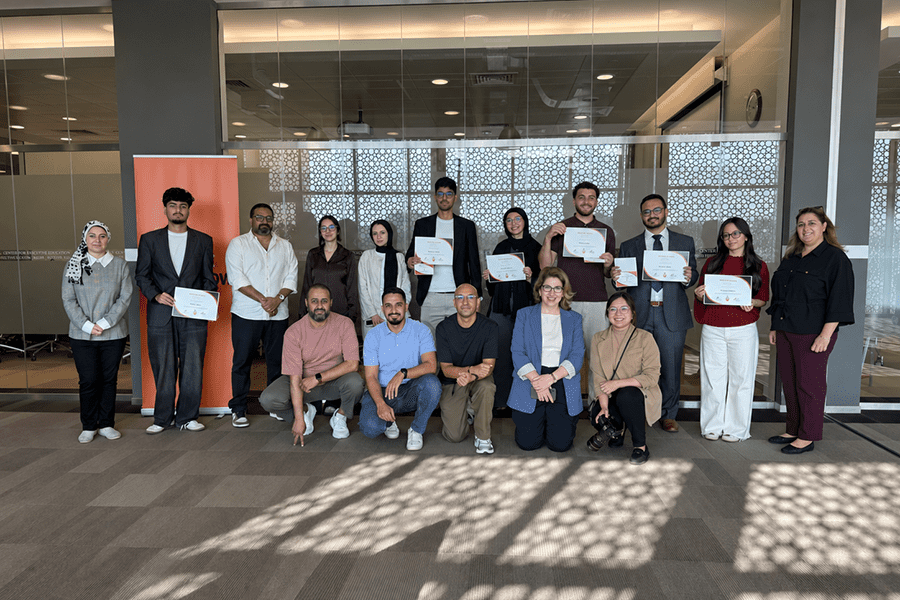
A delivery promise that changes at noon. A warehouse shelf that must earn its space. A truck unloading area where workers need better protection. These were among the practical business questions explored by American University of Sharjah (AUS) students in the fourth Amazon Transcend Challenge.
At the AUS final, six students presented their recommendations to a panel of Amazon leaders. Three College of Engineering (CEN) students took the top three places: Ahmed Khaled Elfeky won first place, Muhammad Kashan Qureshi placed second and Rizwanul Abidin Asim placed third.
Five real business cases put student ideas to the test
For the fourth year, the AUS School of Business Administration’s (SBA) Career Design Lab co-organized the challenge with Amazon. This year’s edition drew 447 submissions from students at AUS, American University in Dubai and New York University Abu Dhabi, including 145 from AUS. The AUS final was held on November 2 at the Jafar Center for Executive Education in the SBA Building.
Participants chose from five case studies based on Amazon business challenges in areas including engineering, supply chain, operations, cost and efficiency. They prepared concise written recommendations rather than relying on presentation slides. At the final, judges read each student’s document and questioned them about their analysis and proposed solution.
The six AUS finalists were CEN students Elfeky, Qureshi, Asim and Syed Musab Kazim, and SBA students Khwaish Makhijani and Habiba Talal Akeil Wishah.
First place: Ahmed Elfeky engineers a safer way to unload trucks
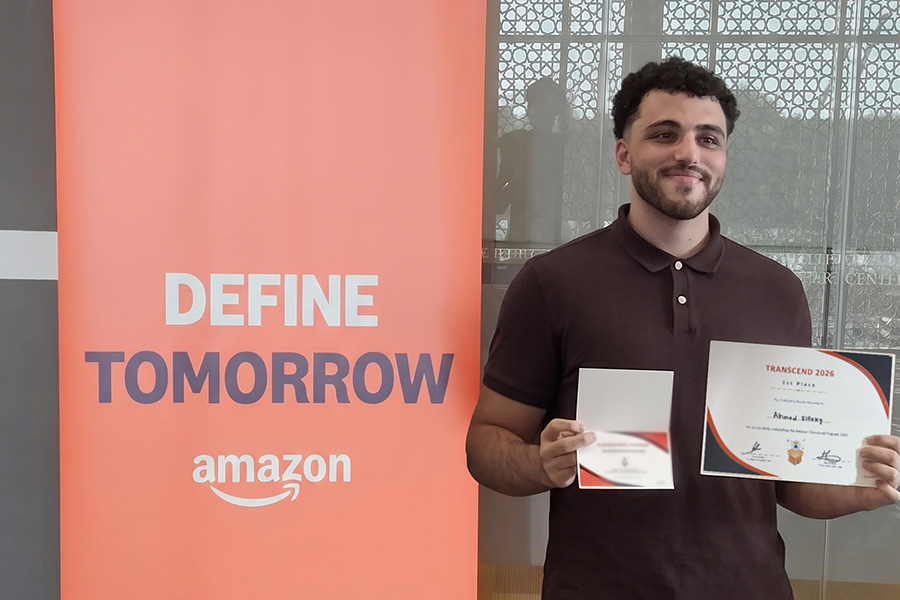
A senior computer engineering student, Elfeky chose a case focused on workplace safety during truck unloading. His proposal, SafeSpan, outlined sensor-controlled bridges and safety equipment designed to protect workers without requiring changes to trucks or loading docks.
“I wanted SafeSpan to be a practical engineering solution that could improve safety without requiring changes to existing trucks or docks. I developed the design, calculations and supporting diagrams myself, then explained how the system would work and answered the judges’ questions,” said Elfeky.
Second place: Muhammad Kashan Qureshi asks inventory to “earn the space”
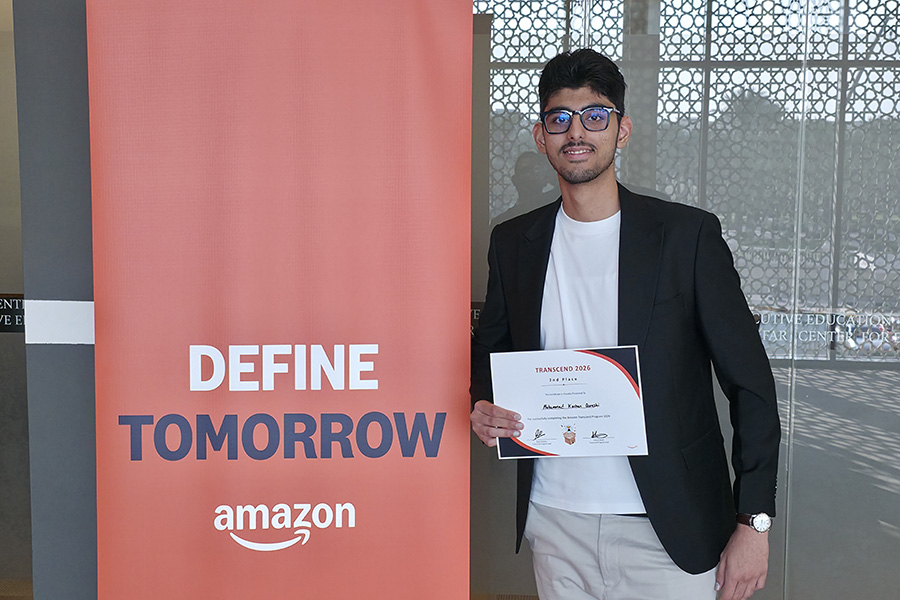
Qureshi, a sophomore industrial engineering student, entered the case “Placing Inventory Closer to the Customer,” which asked how Amazon UAE could decide which products to keep in forward warehouses near cities to support same-day delivery.
His recommendation, “Earn the Space,” proposed a weekly decision rule: a product should be kept in a forward warehouse when the profit from faster delivery exceeds the cost of holding it there. He also proposed using generative artificial intelligence to forecast local demand, including seasonal shifts, and piloting the approach before expanding it.
“I wanted the proposal to measure success by the customer orders that could be delivered the same day, rather than simply by the amount of inventory held nearby. The pilot would also let Amazon test the approach before a wider rollout,” said Qureshi.
Third place: Rizwanul Asim builds a smarter, testable delivery strategy
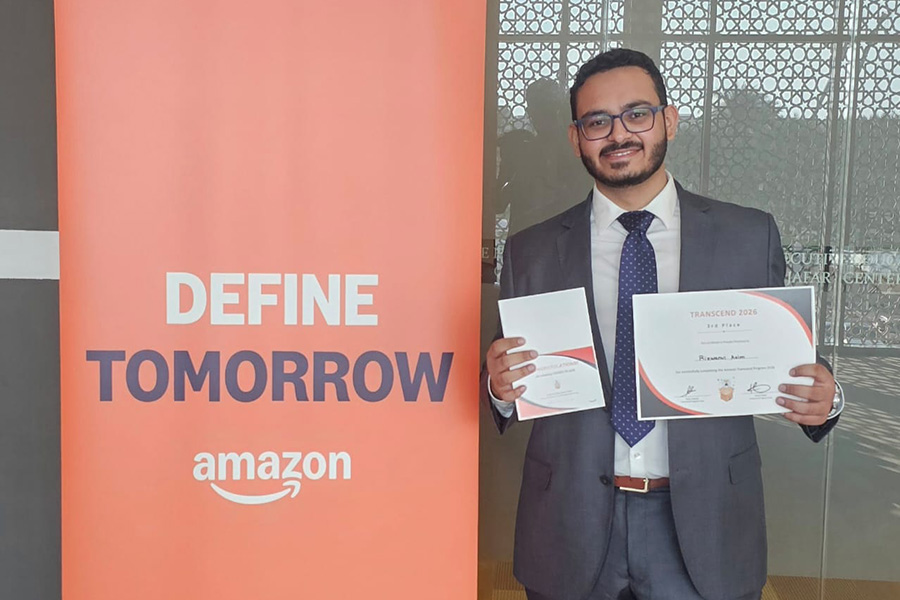
A senior computer engineering student, Asim focused on how quickly Amazon UAE should promise delivery in different areas and how to assess the return on that investment. His proposal recommended setting delivery targets by zone, based on customer demand and delivery economics, instead of applying one target across the country.
He supported the recommendation with a financial model and Speed Compass, a web app that allowed judges to change assumptions and see how the targets responded. The app also simulated a test using the daily noon change in Amazon’s delivery promise and included an AI feature to classify shopping searches in English and Arabic as urgent or not.
“I wanted the judges to be able to test the assumptions themselves. Speed Compass connected the written recommendation to a working model and showed how Amazon could test the plan before making a larger investment,” said Asim.
The three winners will receive internship opportunities at Amazon, with placements lasting between three and six months.
Career Design Lab connects classroom thinking with industry challenges
“What stood out in this challenge was the students’ ability to look beyond the technical aspects of a problem and consider its wider business implications. They demonstrated the analytical thinking, creativity and commercial awareness needed to turn complex challenges into practical solutions. This is precisely the kind of talent industry needs, and the kind of experience we want our students to gain before they graduate,” said Eleni Papailia, Senior Manager of the Career Design Lab.
The Career Design Lab provides career services for students, fresh graduates and employers, including internship placements, recruitment events, the iLead Career Preparation Program and executive education. It also serves as the main point of contact for professional and community partners engaging with the School of Business Administration. Learn more at the Career Design Lab.

By continuing, you will be taken to a website not affiliated with American University of Sharjah. Links to external sites are provided only for users' convenience and imply no endorsement of the site and/or its content. Note that the privacy policy and security settings of the linked site may differ from those of the AUS website.