Latest News
October 1, 2026
September 30, 2026
September 29, 2026

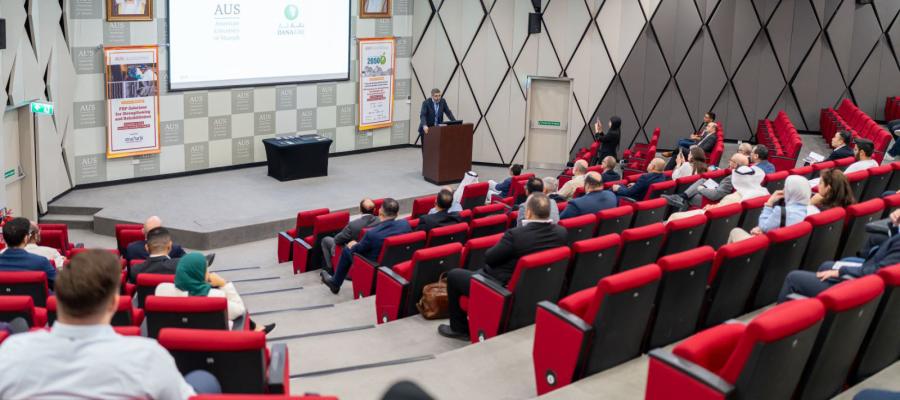
American University of Sharjah (AUS), with the support of the Dana Gas Endowed Chair in Engineering, recently hosted a two-day workshop titled “Towards Enhanced Structures and Sustainable Construction: FRP Solutions for Strengthening, Rehabilitation and Internal Reinforcement” on December 9–10, 2025. The event brought together more than 100 international experts, industry leaders and practicing engineers to explore the latest developments in the use of fiber-reinforced polymer (FRP) technologies for reinforcing and strengthening concrete structures, with a particular focus on codes, standards, design practices and sustainable aspects of FRP.
On the first day, the sessions focused on externally applied FRP for structural repair and strengthening. Dr. Tarek Alkhrdaji reviewed current FRP design codes, theories, detailing for gravity and seismic loads, and discussed inspection and quality control methods. Mustafa Al-Mimar, Structural Engineer at SIMCO Technologies, presented case studies of successful strengthening projects, highlighting challenges, lessons learned and best practices.
On the second day, Dr. Antonio Nanni from the University of Miami presented FRP bars for concrete reinforcement, covering their types, properties, benefits and key design concepts using ACI Code 440.11-2022 with practical examples. Dr. Tao Yu, Professor of Structural Engineering at The Hong Kong Polytechnic University, representing the International Institute for FRP in Construction (IIFC), discussed FRP-reinforced seawater sea-sand concrete systems as an emerging solution for sustainable construction, while Valery Hurynovich, CEO of ABFC – Basalt Powered, presented the potential of basalt FRP reinforcement as a high-performance material for demanding environments.
Additional sessions examined cutting-edge practical applications. Hussam Nasreddin, Senior Design Innovations Manager at NEOM, spoke about GFRP-reinforced foundations for wind turbines, and Eid Bader and Dr. Julien Saade of IKK Mateenbar discussed the sustainable role of GFRP rebar in modern construction. Parthasarathy Devarajan of Union Cement Company offered the cement industry’s perspective on innovative reinforcement and material solutions. The workshop concluded with a lecture by Dr. Farid Abed, Professor of Civil Engineering and Dana Gas Endowed Chair in Engineering at AUS, on fire resistance of FRP-reinforced concrete structures and other advanced applications.
Commenting on the significance of the workshop, Dr. Fadi Aloul, Dean of the AUS College of Engineering, said: “As a college, we are focused on engineering solutions that enhance the resilience and sustainability of infrastructure in our region and beyond. By bringing global authorities on FRP to our campus and connecting them with industry partners and our own faculty and students, this workshop created a direct link between international codes, cutting-edge research and real-world design and construction. The support of the Dana Gas Endowed Chair in Engineering is central to our ability to host such impactful technical programs at AUS.”
Reflecting on the outcomes, Dr. Farid Abed highlighted the growing maturity of FRP technologies and their relevance to the region’s infrastructure agenda.
“Fiber-reinforced polymer composites have evolved from niche materials into practical, competitive options for strengthening and reinforcing concrete structures. Over these two days, we connected decades of research with the everyday decisions that engineers make in design offices and on construction sites. The depth of questions and interaction confirmed a strong appetite for solutions that improve durability, reduce corrosion-related maintenance and support more sustainable construction practices. The Dana Gas Endowed Chair in Engineering plays a vital role in enabling us to convene this level of expertise at AUS,” he said.
The event was made possible through the support of a broad network of partners, with S.P.M.E. Middle East General Contracting as main partner; supporting partners Mateenbar Limited Group, Arab Basalt Fiber Company; and contributing partner Union Cement Company. The workshop also benefited from the involvement of supporting organizations, including the American Concrete Institute and the International Institute for FRP in Construction, which helped connect local practice with global standards and professional communities.
Expanding on the impact of this workshop, Bill Hutton, General Manager for S.P.M.E Middle East General Contracting, stated: "At Structural Group, we proudly align with the UAE’s vision for a sustainable and resilient future by FRP solutions for the strengthening of structures. For more than 25 years, we have been at the forefront of developing, advancing, and implementing FRP technologies, extending the life of infrastructure, minimizing carbon impact and supporting the nation’s commitment to sustainable construction. Our commitment goes beyond products, focusing on long-term solutions that support a greener future for the communities we serve.”
Established in 2011 under the name Dana Gas Chair in Chemical Engineering and later expanded as the Dana Gas Endowed Chair in Engineering, this endowed position was created to strengthen AUS’ capacity in high-impact engineering research and innovation. It supports faculty research, student projects, laboratory development and collaboration with industry and international partners, thereby advancing the university’s research mission and reinforcing AUS’ role as a leading research-active institution in the region.
By continuing, you will be taken to a website not affiliated with American University of Sharjah. Links to external sites are provided only for users' convenience and imply no endorsement of the site and/or its content. Note that the privacy policy and security settings of the linked site may differ from those of the AUS website.