Latest News
October 1, 2026
September 30, 2026
September 29, 2026

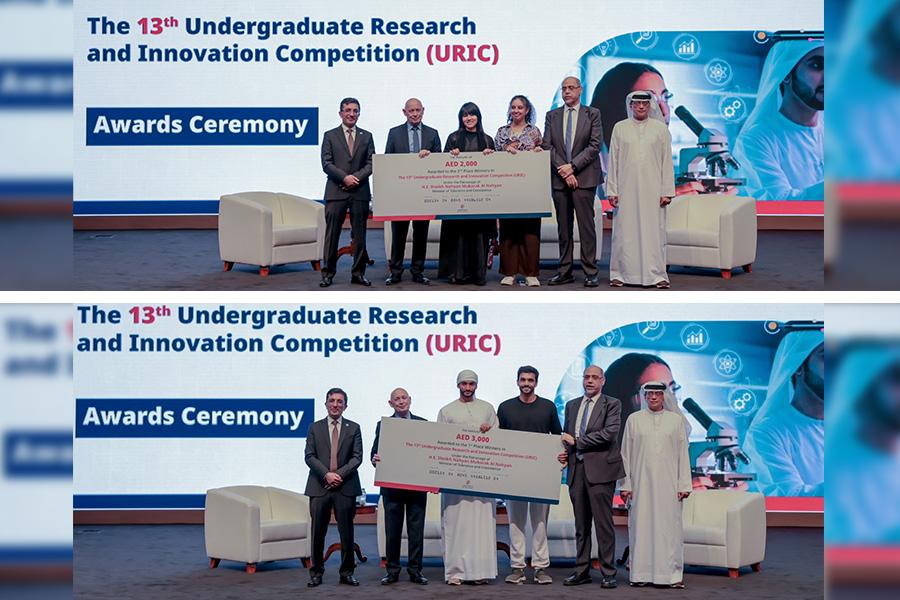
Three student teams from American University of Sharjah (AUS) returned from the 13th Undergraduate Research and Innovation Competition with top honors, winning first and second places across engineering and basic sciences categories and showcasing student-led projects that address real-world challenges through practical innovation and applied research.
Organized and hosted by Abu Dhabi University, the Undergraduate Research and Innovation Competition is a regional platform that promotes undergraduate research and applied innovation across major disciplines. Held on May 21, 2026, the 13th edition brought together more than 1,350 undergraduate students presenting over 500 research projects from more than 71 universities, with entries spanning 24 strategic disciplines including healthcare, sustainability, artificial intelligence and emerging technologies.
First place in mechanical engineering
Mechanical engineering students Meera Marwan Aljasmi and Khalifa Hassan Alawadhi won first place in the Engineering Project category, Mechanical Engineering sub-category, for their project “Sound Wave Fire Extinguisher.”
The project explores the use of low-frequency sound waves as an alternative method for fire suppression. Unlike conventional fire extinguishers that rely on water, foam or chemicals, the system uses acoustic waves to disrupt combustion and extinguish flames. The students designed and built a functional prototype consisting of a subwoofer, amplifier and acoustic funnel operating at 40 Hz.
They tested the prototype on different flame types, including candles, lighter fluid, lighter gel, lighting cubes and petrol, demonstrating that low-frequency sound waves can extinguish flames without leaving residue or causing damage in spaces where conventional extinguishing methods may create additional damage, including electrical control panels, server rooms and other sensitive environments.
“We wanted to test whether sound could be used as a practical method for fire suppression,” said Aljasmi. “The idea was to explore a cleaner option for places where water or chemicals may not be suitable.”
Alawadhi said the value of the project was in proving the concept through experimentation.
“What made the project strong for us was that it was not only theoretical,” he said. “We designed the system, built the prototype and tested it on different flame sources. The results showed us that the idea has practical potential.”
Their advisors, Dr. Mehdi Ghommem, Associate Professor of Mechanical Engineering and Associate Dean for Research, Innovation and Outreach, and Dr. Rami Hawileh, Professor of Civil Engineering and Riad T. Sadik Chair, said the project reflected the importance of hands-on engineering and careful validation.
“They took a scientific idea and examined it through design and experimentation,” said Dr. Ghommem. “That process is important because it teaches students how to move from a concept to a system that can be tested, measured and improved.”
Dr. Hawileh said the students’ approach helped strengthen the project.
“They did not simply present an idea,” said Dr. Hawileh. “They built a working prototype, tested it under different conditions and used the results to think about how the system could be developed further.”
Aljasmi and Alawadhi plan to continue improving the system by making it more compact, intelligent and practical for real-world applications. Their next steps include integrating fire-detection sensors, adding automatic targeting and maneuvering capabilities, miniaturizing the system for use in sensitive environments, exploring portable handheld versions and further optimizing acoustic frequencies to improve efficiency and performance.
The team also produced a video demonstration showing the project concept, prototype and testing process.
First place in basic sciences
Chemistry and biochemistry student Sunehra Shoeb won first place in the Basic Sciences category for her project “Synthesis of Glucose-Derived Carbon Dots and Evaluation of Their Photocatalytic Performance for Organic Waste Degradation Using Methylene Blue as a Model Pollutant.”
Mentored by Hamza Sabouni, PhD student in Materials Science and Engineering, under the supervision of Dr. Almaz Jalilov, Professor of Biology, Chemistry and Environmental Sciences at AUS, the project focuses on developing sustainable nanomaterials for water purification.
Shoeb synthesized carbon dots from glucose using a simple, environmentally friendly solvent-free pyrolysis method and investigated their ability to degrade organic pollutants in water through photocatalysis. The synthesized carbon dots were characterized using analytical techniques to examine their structural and optical properties, then tested using methylene blue, a commonly used model pollutant.
The results showed that the glucose-derived carbon dots were capable of degrading nearly 70 percent of the dye under light irradiation, highlighting their potential as low-cost and environmentally compatible materials for wastewater treatment.
“I believe our project stood out because it combined scientific innovation with sustainability and real-world relevance,” said Shoeb. “During my presentation, I made a conscious effort to highlight the significance of this research in the UAE context, where water scarcity remains a major challenge and there is a growing need for sustainable water treatment solutions.”
Shoeb said one of the most unique aspects of the project was its simplicity.
“The carbon dots were synthesized from glucose, which I described in my presentation as just a spoonful of sugar, using a straightforward heating process,” she said. “Unlike many conventional nanomaterials that require complex synthesis routes or potentially hazardous chemicals, our approach shows that effective photocatalytic materials can be produced from simple and sustainable starting materials.”
Sabouni said the project was compelling because it connected laboratory work to a pressing environmental challenge.
“Sunehra approached the project with curiosity, discipline and a strong understanding of the scientific problem,” said Sabouni. “The work was strengthened by the way she connected the experimental results to the broader need for sustainable water treatment technologies.”
Dr. Jalilov said the project reflects the value of giving undergraduate students meaningful opportunities to participate in research.
“This project allowed Sunehra to experience the full research process, from developing the material and testing its performance to communicating the significance of the results,” said Dr. Jalilov. “It is a strong example of how undergraduate research can connect scientific learning with issues that matter to society.”
Shoeb said the project was especially meaningful because it gave her the opportunity to participate in research as an undergraduate student.
“One aspect I would particularly like to highlight is the opportunity I was given to participate in research as an undergraduate student,” said Shoeb. “I am deeply grateful to Dr. Jalilov for welcoming me into his research group and allowing me to contribute to ongoing research projects. I was also fortunate to work closely with my mentor, Hamza Sabouni, who was instrumental throughout this project.”
She added that the experience helped her understand the research process beyond the classroom.
“This experience allowed me to go beyond the traditional classroom and laboratory exercises typically confined to the syllabus,” she said. “For the first time, I was able to engage in the real process of scientific discovery, asking questions, testing ideas, analyzing unexpected results and learning through trial and error.”
Moving forward, Shoeb hopes to further investigate the photocatalytic performance of glucose-derived carbon dots under more realistic environmental conditions and explore ways to improve their efficiency.
She is also interested in exploring the biomedical potential of carbon dots, including their possible use in drug delivery, imaging and other clinically relevant applications.
Shoeb also submitted a presentation video for the competition, explaining the project concept, methodology and results. The video can be viewed here.
Second place in electrical and electronic engineering
Electrical engineering students Salsabeel Elsharkawy, Noof Alzarooni and Ahmad Al-Refaei won second place in the Electrical and Electronic Engineering category for their senior design project “Real-Time Adaptive Noise Suppression for Auditory Stress Mitigation in Sound Sensitive Epileptic Individuals.”
The project focuses on individuals with sound-sensitive epilepsy, who may be affected by sudden sharp sounds such as a heavy door slam. Rather than blocking the surrounding environment, the team’s project proposes a real-time adaptive noise-suppression headset that targets sudden sharp sounds both mechanically and digitally.
The system continuously analyzes incoming audio by calculating the root mean square energy of the acoustic environment. When it detects a sudden energy spike, it suppresses the sharp sound before it becomes a trigger, while still allowing the user to hear conversations and remain aware of their surroundings.
“For us, the project was about protection without isolation,” said Elsharkawy. “We wanted the headset to reduce sudden harmful sounds while still allowing users to hear speech and interact safely with their environment.”
The project stood out because it addressed a serious medical issue that can affect people’s daily routines and sense of safety.
“Standard noise cancellation can reduce sound, but it can also cut people off from what is happening around them,” said Alzarooni. “We wanted our system to be protective while still being practical for everyday life.”
Their submission video helped explain the human side of the challenge, while their semi-working software prototype showed that the concept had moved beyond the idea stage.
“The prototype helped us show that we were serious about building the solution,” said Al-Refaei. “It is still developing, but it showed that our concept has real potential and gave us a clear direction for the next phase.”
Following their win, the team is focusing on hardware integration. Their next step is to embed a compact computer board that can process audio data and run the team’s algorithm within a 3D-printed headphone prototype. The design will also include tiny high-sensitivity microphones commonly used in compact electronic devices, along with an integrated power system. The team is also exploring fabrication support and plans to refine the filtering algorithm to reduce audio artifacts, including the switching and scratchiness observed in early tests, while improving overall attenuation performance. On the software side, the students aim to develop a user-friendly interface with LED indicators and physical controls to make the device more intuitive for users.
Longer term, with the encouragement of their advisor Dr. Hasan Mir, Professor of Electrical Engineering, and co-advisor Dr. Lutfi Albasha, Professor of Electrical Engineering and Coordinator of the Engineering and Technology Product Design Program, the team is exploring the possibility of developing the project into a startup focused on a non-invasive assistive solution for individuals living with sound-sensitive epilepsy.
“What I appreciated in this project was the clarity of its purpose,” said Dr. Mir. “They were thinking carefully about a specific group of users and how engineering could help reduce a real daily risk.”
Dr. Albasha said the project reflects the value of senior design work that connects technical learning with user needs.
“The students brought together signal processing, hardware thinking and user-focused design,” said Dr. Albasha. “What makes the work important is that it treats engineering not only as a technical exercise, but as a way to respond to a problem that affects people’s lives.”
Elsharkawy said the project benefited from support that helped the team keep refining the idea.
“Dr. Hasan Mir and Dr. Lutfi Albasha believed in the project from the beginning and pushed us to keep improving it,” she said. “The support of the Department of Electrical Engineering and our families also helped us stay focused as the project developed.”
To learn more about CEN and its role in advancing student innovation, click here.
By continuing, you will be taken to a website not affiliated with American University of Sharjah. Links to external sites are provided only for users' convenience and imply no endorsement of the site and/or its content. Note that the privacy policy and security settings of the linked site may differ from those of the AUS website.