Latest News
October 22, 2026
October 21, 2026
October 20, 2026

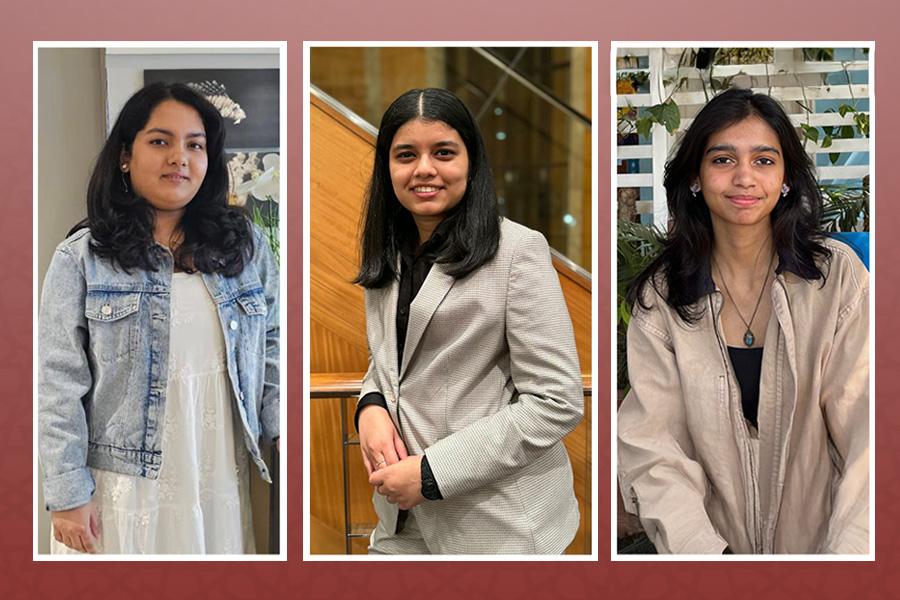
A fashion idea typed into a computer took three American University of Sharjah (AUS) graduates from a classroom assignment to an international stage in Berlin, where their work on using artificial intelligence (AI) to turn written prompts into realistic digital garment designs won the Best Presentation Award at the 11th International Conference on Machine Learning Technologies 2026.
The project addresses a practical challenge in AI-assisted fashion design. Image-generation tools can create attractive visuals, but they often miss the accuracy needed for real garment design. A prompt describing a tailored blazer, floral sundress or asymmetrical jacket should produce an image that reflects the garment’s structure, material, silhouette and design details, rather than a vague fashion-inspired picture.
To address this, the AUS team developed an approach that keeps the main image-generation system unchanged and adds a smaller fashion-focused guide to direct it. This means the system can produce results that are closer to the designer’s description without the high cost, time and computing power usually needed to retrain large AI models. The approach could make AI-assisted design more accessible, allowing designers and brands to turn written descriptions into realistic visual prototypes faster and with fewer physical samples.
The winning paper, “From Words to Wardrobe: CLIP-Guided Diffusion for Fashion Design,” was developed by Sana Valappil, a computer science graduate, and Gayatri Lakshmi and Elisha Mary Thomas, computer engineering graduates, all of whom graduated from AUS in Spring 2025. The students were guided by Dr. Imran Zualkernan, Head of the Department of Computer Science and Engineering at AUS, who helped shape the idea and research approach, and Ali Reza Sajun, Laboratory Instructor in the department, who supported the team in developing the work into a publishable research paper. Sajun represented the team at the conference in Berlin.
“We wanted to make AI respond to fashion ideas in a way that feels useful for design,” said Sana Valappil. “Fashion depends on small details. A change in silhouette, material or pattern can change the entire look. Our goal was to help the model pay closer attention to those details and produce images that better match the description.”
For designers and brands, the research could support faster early-stage design. A designer could describe a garment in words and receive a realistic visual prototype in seconds, helping reduce physical sampling and making digital prototyping easier for independent designers and smaller fashion brands.
“What made the project exciting was that it had a clear real-world use,” said Gayatri Lakshmi. “We could see how this kind of tool might help designers explore ideas quickly before moving into sketches, samples or production.”
Sajun said the work offers a practical way to make advanced AI easier to apply in specialized fields.
“What the students demonstrated is a smarter and more accessible way to make AI useful for a field such as fashion,” said Sajun. “Instead of rebuilding the entire system, they showed that it can be guided in the right direction using a focused layer of intelligence that understands the design context. This means the image produced is closer to what the designer actually describes, whether that is the garment’s structure, texture, pattern or overall style. What also makes the work meaningful is that it grew naturally from a course assignment into a publishable research paper because the students had the curiosity to push further and the department had the support structure to help them do that.”
For the students, the recognition is especially meaningful because this is their first research paper and the first publication of the project.
“Seeing a class project become a research paper was already a proud moment,” said Elisha Mary Thomas. “Winning Best Presentation made it even more meaningful. It showed us that undergraduate research can contribute to important conversations in machine learning and creative technology.”
Dr. Zualkernan said the achievement reflects the classroom-to-research pathway the Department of Computer Science and Engineering continues to foster.
“For three undergraduates to take a class project, develop it into a full research paper and have it recognized at an international machine learning conference is a remarkable achievement,” said Dr. Zualkernan. “It shows that with strong classroom instruction, the right mentorship and student drive, undergraduate work can stand alongside contributions from established researchers. It also reflects what we are building in the department: a culture where students are encouraged to move beyond theory, apply what they learn to real problems and receive support through the full research journey, from idea development to publication and presentation.”
The AUS College of Engineering prepares students for rapidly evolving industries through rigorous programs led by accomplished faculty and grounded in applied learning, research exposure and real-world problem-solving. This direction is further advanced through CEN 2.0 Innovation, which embeds artificial intelligence, data analytics, entrepreneurship and advanced technologies across undergraduate and graduate curricula, supported by modern laboratories, hands-on experimentation and stronger pathways to workplace readiness. Click here for more information about the college and its offerings.

By continuing, you will be taken to a website not affiliated with American University of Sharjah. Links to external sites are provided only for users' convenience and imply no endorsement of the site and/or its content. Note that the privacy policy and security settings of the linked site may differ from those of the AUS website.