Latest News
October 13, 2026
October 13, 2026
October 12, 2026
October 12, 2026

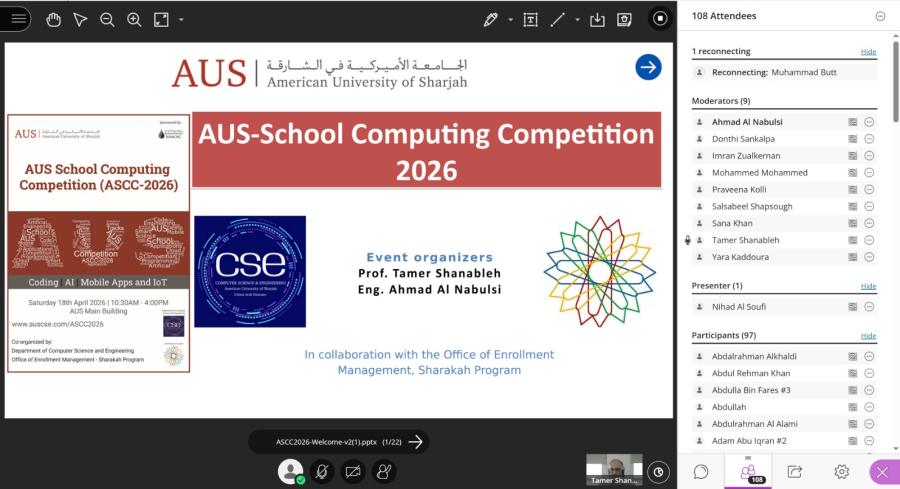
When learning shifted online across the UAE, students still found a way to create and push their ideas further. That was the spirit behind the AUS School Computing Competition (ASCC) 2026, which brought together 140 students from Grades 10 to 12 representing 27 schools across the UAE to solve coding challenges, develop practical solutions and sharpen their problem-solving, teamwork and presentation skills.
Organized by the Department of Computer Science and Engineering in the AUS College of Engineering in collaboration with the Office of Enrollment Management–Sharakah Program, the competition featured three tracks: General Programming, Python Programming for Artificial Intelligence (AI), and Mobile Application Development and/or Internet of Things (IoT) applications, giving the 49 teams of students the opportunity to solve problems, build projects and present their work in a supportive yet challenging environment.
“This competition reflects the commitment of the AUS College of Engineering to empowering young minds with the skills and confidence needed to lead in a technology-driven world. By engaging students in real-world computing challenges, we are helping shape the next generation of innovators and problem solvers,” said Dr. Tamer Shanableh, Chair of the Organizing Committee and Professor of Computer Science and Engineering at AUS.
The competition was co-organized by Ahmad Alnabulsi, Senior Laboratory Instructor in Computer Science and Engineering, and judged by lab instructors and graduate teaching assistants from the department.
Tracks 1 and 2 followed a hackathon format, with teams solving programming challenges within a fixed time and being evaluated on correctness, completeness, efficiency, user experience, error handling and their performance during the judges’ questions and answers. Track 3 focused on mobile app or IoT-based solutions developed in advance and presented to the judges.
The projects presented in Track 3 reflected the many ways students are already thinking about technology as a tool for solving real problems. They explored themes such as robotics, waste management, smart education, smart parking and smart agriculture, showing both creativity and an understanding of how computing can be applied in everyday life.
For Abdulla Alahmadi, a Grade 11 student from Dubai National School—Al Twar, the competition was a chance to test his skills and see where they could take him.
“I chose the computer programming track because I have a strong interest in technology and problem-solving, and I was excited by the opportunity to challenge myself in a competitive environment. Participating in this competition was a rewarding and challenging experience that pushed me to work efficiently under pressure and apply my programming knowledge in practical situations. I learned how to approach problems more strategically, improving my coding skills, debugging techniques and time management. I also enjoyed collaborating with others, gaining experience in critical thinking, teamwork and adapting to new challenges quickly. This experience has motivated me to continue improving my skills and explore more opportunities in computer programming, and I would certainly consider computer science as a future career. It combines creativity with logical thinking, offering endless opportunities to innovate, build useful applications and solve real-world problems through technology,” he said.
The competition concluded with awards for the top three teams in each track. First-place winners received AED 1,500 per team, second-place winners received AED 1,200 and third-place winners received AED 900, along with certificates and prizes.
In Track 1, General Programming, first place went to Muhammad Butt, Alman Ahmad and Muhammad Abdullah Irfan from GEMS Westminster School, Sharjah. Second place went to Sary Nassif, Mohammad Nasser Alsous and Zain Soliman from Al Mawakeb School, Barsha. Third place went to Srihitha Aileni, Vishva Pitroda and Avnitha Edayilliam from Sharjah Indian School.
In Track 2, Python Programming for AI, first place went to Ousama Alhennawi from AlMa’arifa International Private School. Second place went to Wessam Tinawi and Abdalrahman Alkhaldi from Sama American Private School, Boys Branch. Third place went to Lana Fayyad and Hasnaa Ahmed from Sama American Private School, Girls Branch.
In Track 3, Mobile App Development and/or IoT Applications, first place went to Saeed Alfalasi and Omar Senjab from Greenwood International School. Second place went to Hanan Inayat, Suha Suneesh and Omar El Sayed from Sharjah English School. Third place went to Zainab Gilani and Ivan Rukin from Safa Community School.
ASCC 2026 was sponsored by Sharjah National Oil Corporation (SNOC), with funding for the event provided through the SNOC Energy, Environment and Innovation Fund established at AUS, whose support contributed to the success of this year’s competition and reflected the value of partnerships that invest in student learning and future talent.
Khamis Al Mazrouei, CEO of SNOC, said: “At SNOC, we believe that investing in young talent is investing in the future of our industry and our nation. The AUS School Computing Competition is a platform that nurtures exactly the kind of creative, solutions-driven thinking that the energy sector will need in the years ahead, and we are proud to support it through the SNOC Energy, Environment and Innovation Fund."
Through the AUS Department of Computer Science and Engineering students pursue undergraduate and graduate studies in computer science, computer engineering and machine learning within a learning environment shaped by artificial intelligence, data science and smart cities. With hands-on laboratories, industry-sponsored graduation projects and internationally accredited programs, the department equips students with the knowledge and practical experience needed to thrive in a rapidly evolving field. Click here to learn more about the department’s offerings.

By continuing, you will be taken to a website not affiliated with American University of Sharjah. Links to external sites are provided only for users' convenience and imply no endorsement of the site and/or its content. Note that the privacy policy and security settings of the linked site may differ from those of the AUS website.