Latest News
March 26, 2026
March 25, 2026
March 7, 2026

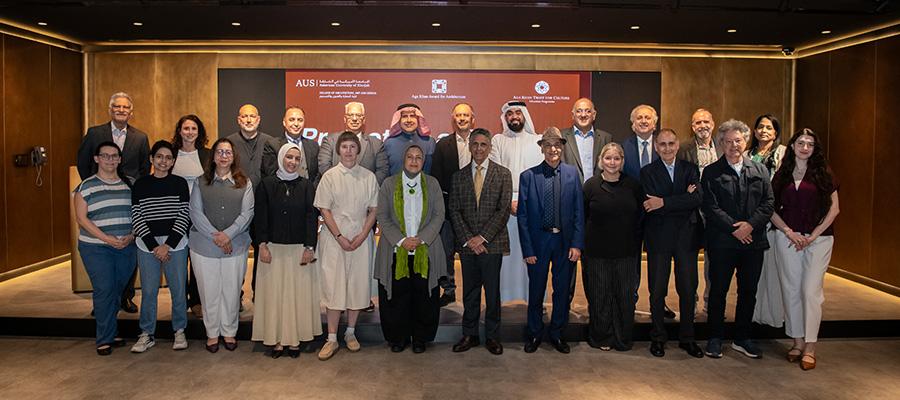
American University of Sharjah (AUS) recently welcomed leading scholars, practitioners and students from across the Arab world at a two-day symposium examining the legacy and pedagogical impact of the Aga Khan Award for Architecture. Held January 21–22 at AUS, the event explored how the award’s 50 years of work has shaped architectural practice, heritage conservation and architectural education in the region.
Organized by AUS at the initiative of and in collaboration with the Aga Khan Trust for Culture Education Programme and the Aga Khan Award for Architecture, the symposium brought together partner architecture schools from Egypt, Jordan, Saudi Arabia, Tunisia, Morocco and the UAE under the title “Promoting a Regional Architecture in the Arab World: Impact of the Aga Khan Award for Architecture.”
“Unlike other architectural awards that tend to focus on 'starchitecture’, the Aga Khan Award aims to highlight architectural concepts that address development challenges such as poverty, displacement, environmental vulnerability and the pressures of rapid urbanization,” said Dr. Zaki Aslan, Professor of Practice in Architecture at AUS. “We felt that five decades on, it was important to reflect on how this unique award has influenced architectural practice and education.”
“This symposium has made a significant contribution to enhancing architectural education in the Arab World: key insights were shared and a new dynamic of regional cooperation was set in motion”, said Professor Raj Isar, the director of the AKTC Education Programme.
About the Aga Khan Award for Architecture
Founded in 1977 by His Highness Prince Karim Aga Khan IV, the award, which has a US$1 million triennial prize fund, has singled out projects as diverse as Khudi Bari in Bangladesh, a modular low-cost housing prototype designed for flood-prone areas; the Revitalisation of Historic Esna in Egypt, a heritage-led regeneration initiative supporting local crafts and tourism; and the Wonder Cabinet in Palestine, a multipurpose, non-profit exhibition and production space built with the input of local artisans and contractors, to become a key hub for Palestinian craft, design, innovation and learning.
The award’s evaluation process is also unusually rigorous. Projects must have been completed and in operation for at least one full year, demonstrating their functionality and benefit to their communities. Shortlisted projects are also subject to detailed on-site reviews by independent experts, who carry out interviews and assess the project’s performance in use before a master jury selects the winners.
“All of this has led to an archive of more than 9,000 documented buildings, meaning that the Aga Khan Award for Architecture has become a significant point of reference for regional architects, policy-makers and educators alike,” added Dr. Aslan.
Building a platform for regional collaboration
Over two days at AUS, presentations and discussions addressed themes including heritage-led regeneration, community-centered design, climate-responsive architecture, the social role of public space and the pedagogical use of the award’s archival resources.
“The symposium provided an exceptional platform for critical reflection on the “Aga Khan Award for Architecture” and a much-needed space for a long-term pedagogical and cultural framework. It highlighted how the Award has influenced architectural thinking across different geographies and cultures through ethics, social engagement, and contextual understanding. Most importantly, it reaffirmed the value of reading architecture across time as place-making and evolution through use, adaptation, and lived experience. The learned lessons were significant for both professional practice and education,” said Professor Natheer Abu-Obeid, a Professor of Architecture at the German Jordanian University.
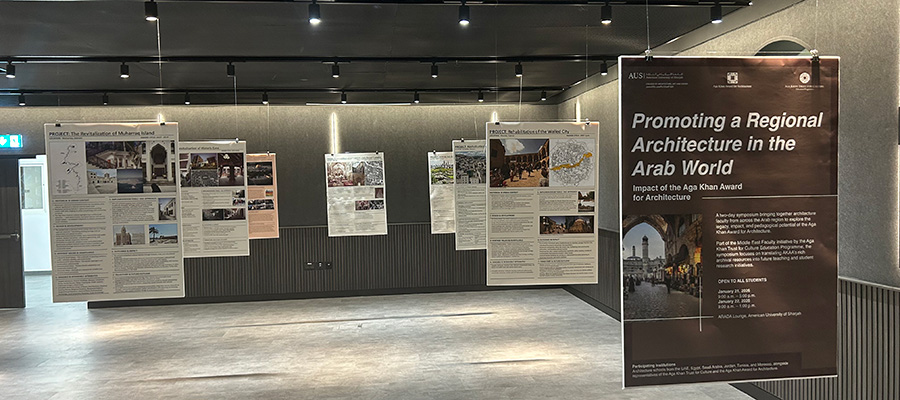
Photo caption: Posters featured included the Rehabilitation of the Walled City in Nicosia, Cyprus and the Revitalization of the Historic Center of Birzeit, Palestine.
The symposium also offered AUS Master of Urban Planning (MUP) students the opportunity to present their research and poster projects on historic cities and heritage-led regeneration, under courses supported by the AKTC Education Programme, including on projects such as the rehabilitation of the walled city in Nicosia, which tackled issues of social reconciliation in Cyprus’ historically divided capital, and the revitalization of the historic center of Birzeit, Palestine, which explained the importance of “preventative conservation” in helping transform a decaying town center into a vibrant social and cultural hub.
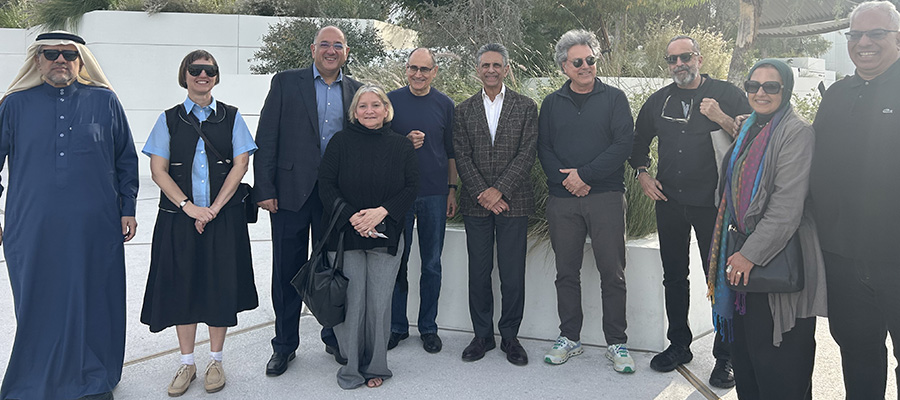
A central component of the event was a workshop on future pedagogical collaboration among partner schools, followed by many of the guests touring Abu Dhabi on January 23 alongside members of the Department of Culture and Tourism – Abu Dhabi (ADCT). The visit was facilitated through Dr. Zaki Aslan’s role as Advisor for the Culture Sector to ADCT and forms part of plans to initiate broader collaboration and knowledge exchange with Abu Dhabi’s cultural and education institutions.
Harnessing the award’s legacy for future generations
Reflecting on the significance of the symposium, Dr. Aslan commented:
“In a regional first, our symposium brought together architects, urbanists and educators from across the region to reflect on how the Aga Khan Award for Architecture has shaped practice, heritage conservation and architectural education over the past five decades. One of the important outcomes was the launch of a regional student research and teaching initiative that will mobilize the award’s archival resources as a learning tool across architecture schools in the Arab world. Through this initiative, we hope to strengthen academic exchange, deepen engagement with heritage-informed design and contribute to a shared architectural culture grounded in cultural sensitivity, sustainability and community engagement.”
For more about CAAD’s leading undergraduate and graduate degree programs in architecture and urban planning, visit www.aus.edu/caad.

By continuing, you will be taken to a website not affiliated with American University of Sharjah. Links to external sites are provided only for users' convenience and imply no endorsement of the site and/or its content. Note that the privacy policy and security settings of the linked site may differ from those of the AUS website.