Latest News
October 13, 2026
October 13, 2026
October 12, 2026
October 12, 2026

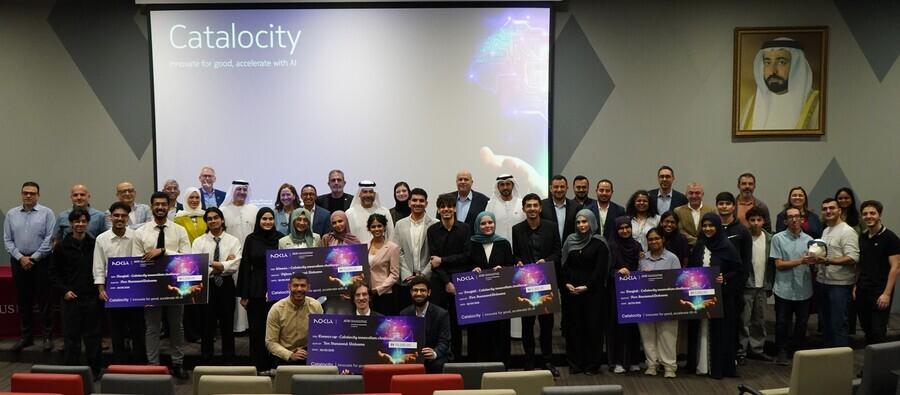
From helping plants survive the UAE’s intense heat to reducing building energy use, improving communication for children of determination and strengthening telecom cybersecurity, students at American University of Sharjah (AUS) turned everyday challenges into practical AI-powered solutions through the Nokia Catalocity Challenge.
Organized by Nokia in collaboration with AUS, the challenge saw students from the AUS College of Engineering explore how AI and telecom-enabled technologies can address challenges related to quality of life, environmental sustainability and communication. The initiative attracted 119 participants and 31 teams, with five teams advancing to the final pitching and award ceremony held at AUS.
An industry-linked platform for applied innovation
The Nokia Catalocity Challenge took students through a structured innovation journey, from team formation and idea development to prototyping, testing, mentoring and final pitching. Participants developed their ideas across three tracks: Quality of Life powered by AI, Quality of Environment powered by AI and Quality of Communication powered by AI.
The finalist teams presented their solutions to a judging panel representing institutions from across the UAE’s innovation ecosystem, including the AUS College of Engineering; e&; Sharjah Research, Technology and Innovation Park; TiE; Nokia and ARDENT Advisory and Accounting.
“Hosting the Nokia Catalocity Challenge at AUS forms part of a wider effort to build an innovation culture where students are empowered to transform ideas into impactful solutions,” said Dr. Fadi Aloul, Dean of the AUS College of Engineering. “The quality and creativity demonstrated by the finalist teams reflect the strength of our experiential learning environment, where students work in multidisciplinary teams to address real-world challenges. Beyond developing technical expertise, these experiences help students strengthen essential soft skills, including teamwork, communication, leadership and problem-solving, while also enhancing their presentation and pitching abilities. Engaging directly with industry leaders allows students to receive valuable feedback, better understand market needs and gain exposure to emerging technologies. These opportunities play a vital role in preparing graduates who can collaborate effectively, think critically and develop innovative solutions that create meaningful impact across industries and communities.”
“The Catalocity Challenge is a strong example of how meaningful innovation starts—by engaging young talent in solving real-world challenges that matter to society. What stands out is the way students have applied AI and digital technologies to address practical needs, from sustainability and energy efficiency to inclusion and communication,” said Danial Mausoof, Senior Vice President and Head of Mobile Infrastructure, MEA, Nokia. “At the heart of this initiative is a focus on ‘AI for good’, which closely resonates with the kind of impact-driven innovation needed in the UAE and beyond. As an innovation-focused company, Nokia is committed to supporting this ecosystem by contributing to the development of local talent and helping equip the next generation with the skills required to build the intelligent systems and networks of the AI era.”
Bloom Buddy wins first place with a solution designed for the UAE climate
The first-place award went to The Bloom Buddies, an all-female AUS engineering team, for Bloom Buddy, an AI-powered smart gardening application designed specifically for the UAE’s extreme climate conditions. Their achievement highlights the growing role of women in engineering and AI innovation. The team includes Saliha Chowdhury, team leader, Nour Aly and Trivandry Samara H.A., all students in intelligent systems and mechatronics engineering; and Manar Walid, an electrical engineering student.
Bloom Buddy addresses a common challenge faced by residents across the country: keeping plants alive in intense heat, rapidly drying soil and indoor environments affected by air conditioning. Unlike many plant care applications developed for more temperate climates, Bloom Buddy is built around UAE-specific conditions.
The application uses a hyper-local onboarding questionnaire to assess each user’s environment, computer vision to identify plants and AI-driven personalized care schedules tailored to UAE climate data. It also includes a community feature connecting users with verified UAE-based horticulture experts, alongside a smart sensor system that tracks soil moisture, temperature, humidity and light levels in real time. This data helps improve the app’s recommendations over time, giving users more accurate plant care guidance.
“Bloom Buddy started with a real challenge we could see around us. Many people in the UAE want to grow and care for plants, but the climate, rapid soil dehydration and air-conditioned indoor spaces make it difficult. Most existing plant care applications are not designed for this environment, so we wanted to create something practical, intelligent and specific to the UAE. Winning the Nokia Catalocity Challenge has reinforced our belief that Bloom Buddy can serve a real community need,” said Saliha Chowdhury, team leader of The Bloom Buddies.
The team plans to further develop Bloom Buddy into an accessible solution for the UAE gardening community, helping residents care for plants more effectively while supporting local sustainability.
Other finalists address energy, sustainability, inclusion and cybersecurity
The other finalist projects showed the range of challenges explored during the competition. Team ReteIntel emerged as second-place winners with ReteIntel: AI-Powered HVAC Optimization, a retrofit solution that uses sensors and AI to improve existing cooling systems and reduce energy waste. Waste Warriors presented WasteRate, an AI-powered sustainability framework for evaluating product impact. Inclusivity developed BayaanAI, a culturally adapted communication platform for children with autism and Down syndrome in the UAE. ZeroG introduced an AI-powered cybersecurity solution that protects users from rogue cellular towers and suspicious mobile network activity.
Preparing students for the future of engineering
AUS’ student innovation outcomes are closely connected to the AUS College of Engineering’s focus on professional and technical preparation, global readiness and leadership development. Through CEN 2.0 Innovation, the college embeds data analytics, AI, entrepreneurship and advanced technologies across the student experience, supported by practical learning, research opportunities and an enhanced internship requirement. This approach is reinforced by AUS’ standing in the QS World University Rankings 2026, where it ranks first in the UAE for employer reputation and second in the UAE for employment outcomes. To learn more about the college, click here.
By continuing, you will be taken to a website not affiliated with American University of Sharjah. Links to external sites are provided only for users' convenience and imply no endorsement of the site and/or its content. Note that the privacy policy and security settings of the linked site may differ from those of the AUS website.