Latest News
October 13, 2026
October 13, 2026
October 12, 2026
October 12, 2026

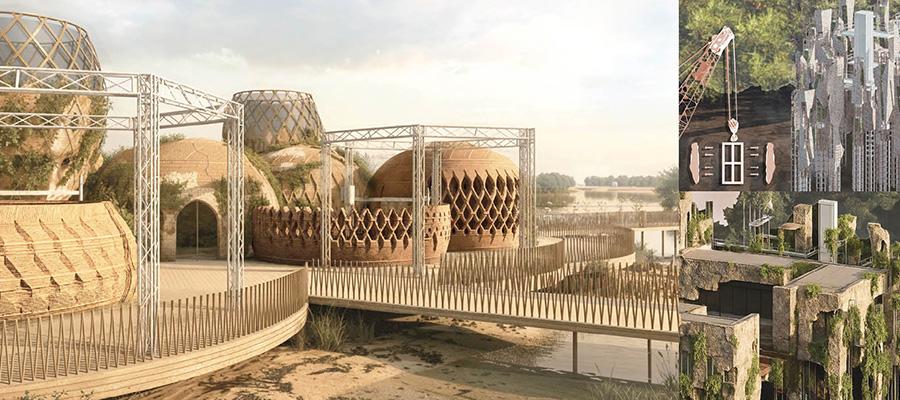
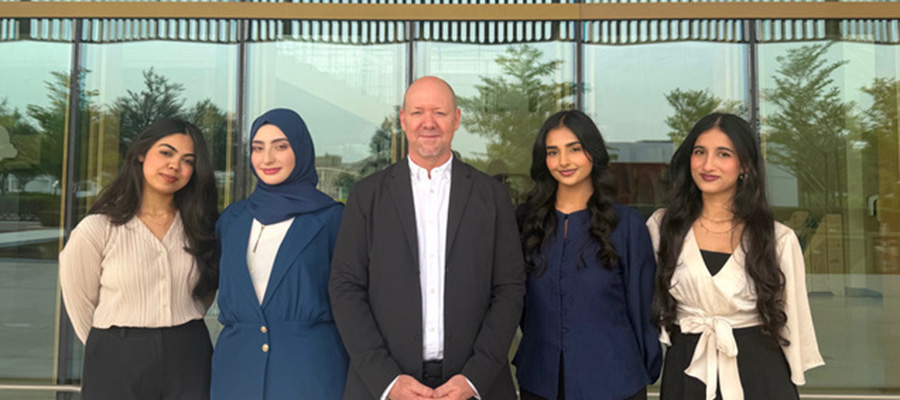
Students from the College of Architecture, Art and Design (CAAD) at American University of Sharjah (AUS), mentored by Marcus Farr, Associate Professor in CAAD’s Department of Architecture, won the Architectural and Cultural Awards at the TURAB Prize: Earthen Futures in the Gulf competition.
Focussing on climate-responsive design in arid environments, a growing priority across the Gulf region, the competition’s inaugural edition was held as part of the 14th TERRA World Congress 2026 in Al Ain, UAE. The event was organized by the Department of Culture and Tourism – Abu Dhabi, in collaboration with the RIBA Gulf Chapter, the regional branch of the Royal Institute of British Architects and the International Scientific Committee on Earthen Architectural Heritage.
The TURAB Prize recognizes innovation in sustainable, culturally grounded earthen architecture which is one of the oldest construction methods in the world. Students were tasked with exploring the theme “Managing Change in Earthen Cultural Landscapes” and developing proposals for the future of architecture in the Gulf.
The AUS teams’ projects were developed as part of the Material Ecologies architecture studio course taught by Farr.
“The studio fundamentally reframes how students think about materials—not as passive components applied to a design, but as generative systems with inherent logics, behaviors and potentials. Ultimately, the work emerging from the studio suggests that earthen architecture in the Gulf is not a return to the past, but a critical pathway toward more sustainable and contextually attuned futures,” Farr said.
“What distinguished both teams was their ability to move beyond representation and use material as a driver of design,” Farr added.
Architectural Award Winner: “Catalysts of Resilience”
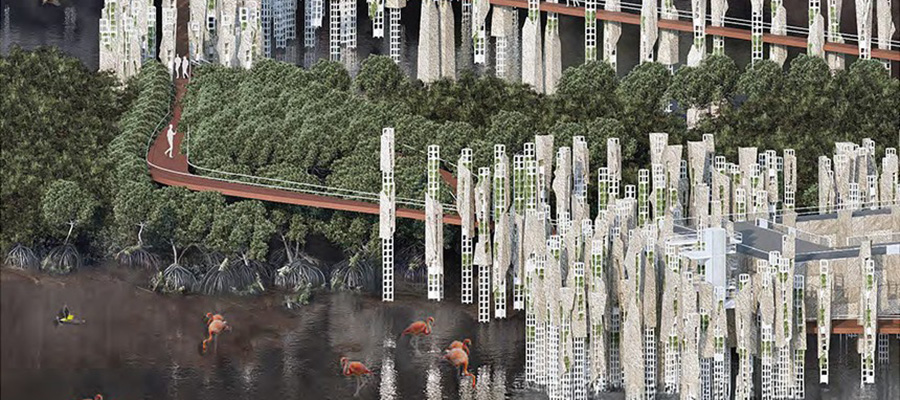
Noor Y. Al-Nakaleh, a fifth-year architecture student, and Tvisha Negandhi, a fourth-year architecture student, won top honors in the Architectural Award for their project “Catalysts of Resilience.” Based in the tidal wetlands of Ras Al Khor Wildlife Sanctuary in Dubai, the project features a wildlife observation center built with eroding limestone and a recycled steel frame.
The Architectural Award recognizes innovation in design and building concepts, with a focus on how earthen architecture integrates with and responds to its surrounding ecology.
The project brief required an intentionally disintegrating structure that would leave the surrounding ecosystem better, or at least as-is, after the structure deteriorates.
Al-Nakaleh described the team’s response to the brief: “The project is designed to fall apart slowly, intentionally and productively. It starts as infrastructure and ends as habitat, gradually returning itself to the ecosystem it was built within.”
Reflecting on the design process, she noted the challenge of rethinking traditional ideas of permanence in architecture while designing with decay and corrosion as core principles.
“For this project, we had to trust the fact that deterioration was the goal,” Al-Nakaleh explained. “The surprising part was how generative that became. Once you accept that a wall will eventually fall, you start asking where it should fall, how fast and what it leaves behind.”
For the team, the win shows the importance of thinking and planning with ecology in mind. “Winning for a project rooted in the Gulf feels meaningful because it shows the region’s urgent and valid contribution to sustainable architecture, shaped by its unique ecology. We are grateful that the Department of Culture and Tourism – Abu Dhabi is creating platforms that acknowledge and invest in student work at this level,” Negandhi said.
“Resilience to climate change is not a distant concern for this region, it is an immediate one. Knowing that institutions are actively encouraging students to engage with it makes this win feel even more significant,” Negandhi added.
Cultural Award Winner: “Material Ecology”
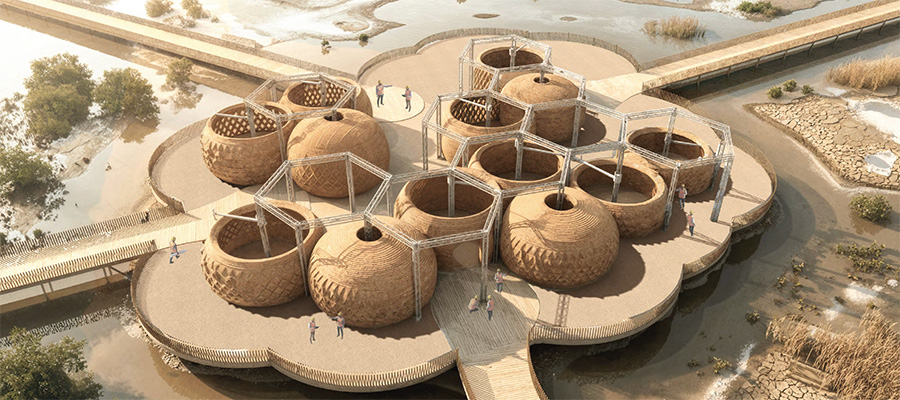
Areebah Juned Siddiqui and Iman Akbar Ali, both fifth-year architecture students, won the Cultural Award for their project titled “Material Ecology.” Their work explores 3D-printed clay as a low-carbon alternative to concrete, responding to the saline environment and local plant life of the wetlands.
The Cultural Award recognizes projects that explore the cultural and experiential dimensions of earthen architecture, focusing on how it is managed, adapted, and integrated with local heritage and environmental contexts.
Speaking about the project, Siddiqui said: “Earthen materials respond directly to climate, moisture, and time through cracking, erosion, and gradual change. Rather than treating change as a limitation, we approached it as a design condition, where weathering, plant growth, and environmental exposure shape how architecture evolves over time.”
The project opened up new possibilities for Siddiqui and Ali, who now view earthen architecture as having far-reaching benefits beyond sustainability and plan to continue building on the research initiated during the competition. “We see it as a way to design architecture that is adaptive, context-specific, and capable of evolving over time,” Ali said.
The rigorous selection process of the TURAB prize highlighted the exceptional caliber of this year's winning projects, testifying to the students' dedication and the quality of mentorship they received.
This recognition adds to a series of recent achievements by CAAD students, including wins at the Pavilion Prize (2025) and the World Architecture Community Awards (2025).
Learn more about CAAD’s programs and initiatives at www.aus.edu/caad.

By continuing, you will be taken to a website not affiliated with American University of Sharjah. Links to external sites are provided only for users' convenience and imply no endorsement of the site and/or its content. Note that the privacy policy and security settings of the linked site may differ from those of the AUS website.