Latest News
October 1, 2026
September 30, 2026
September 29, 2026

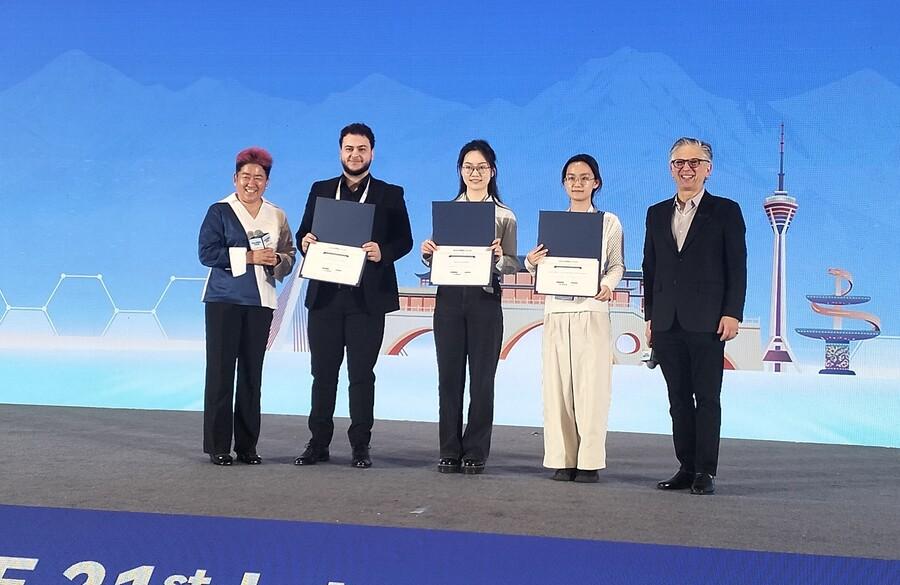
Faris Abdelrazeq, a Master of Science in Mechanical Engineering student at American University of Sharjah (AUS), was recognized for his research at the IEEE’s 21st International Conference on Nano/Micro Engineered and Molecular Systems (IEEE-NEMS). The conference was held in Chengdu, China, in April 2026, where his paper titled “Thermal Localization in Microfluidic Devices Using Auxiliary Heating/Cooling Channels” received the CM Ho Best Paper Award in Micro/Nanofluidics. Co-authored with his supervisor, Dr. Mohamed Abdelgawad, Associate Professor of Mechanical Engineering at AUS, the paper presented an innovative approach to temperature control in micrometer-scale devices.
In his work, Abdelrazeq looked at ways that specific sections of a microfluidic chip (also known as a “lab-on-a-chip”) could be precisely heated or cooled. “Lab-on-a-chip” (LoC) devices are tiny systems that use micro or nano channels to speed up biomedical testing. A single chip can perform sample preparation, mixing, chemical reactions and detection under continuous flow, reducing the waiting time from days to minutes. Traditionally, such systems have relied on complex, and often failure-prone, heat regulators embedded in these channels. Abdelrazeq’s work proposed a simplified alternative to manipulate the temperature of the target channel, making precise temperature regulation more accessible and reliable at the microscale.
“Our approach is like a micro heat-exchanger where auxiliary channels placed next to the main channel enable precise temperature control through conduction and convection,” he said.
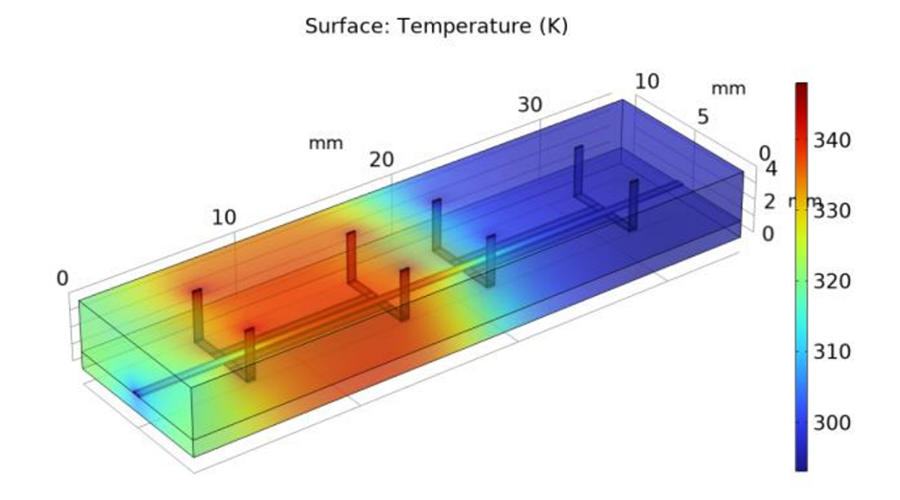
Image: Temperature distribution of a microchannel heated using auxiliary channels.
Abdelrazeq's research aims to improve the efficiency of biomedical diagnostics and enzymatic reactions where localized heating is required.
“The ability to localize heating within a small region of a microchannel can improve reaction efficiency while minimizing unwanted thermal effects on the rest of the sample,” he said.
Various types of LoC examples can be found in rapid PCR testing systems, home pregnancy tests, environmental water testing field-kits and in handheld devices used by diabetics to check blood sugar levels.
Dr. Abdelgawad credited AUS’ research environment and access to industry-standard tools for enabling this kind of work.
“This technique is much simpler and more cost-effective than implementing resistive heaters on-device, which is the most common heating method for such applications. Through this new thermal management approach, we can facilitate biological assays requiring heating or cooling of samples on-chip, such as PCR tests,” he said.
The next stage of Abdelrazeq’s research involves building a working prototype on a chip smaller than 35 millimeters, with channels less than 100 micrometers apart. Working in the AUS Biomedical Engineering lab, he is using a technique known as soft-lithography, which uses light to transfer micrometer-size patterns onto a layer of photosensitive material, to make prototypes and try to validate his findings on these tiny devices.
For more information about the Department of Mechanical Engineering at AUS, visit: www.aus.edu/cen/department-of-mechanical-engineering.
To learn more about the College of Engineering at AUS, visit: www.aus.edu/cen.
About IEEE NEMS
The IEEE is the world’s largest technical professional organization, with more than 500,000 members across more than 190 countries. Sponsored by the IEEE Nanotechnology Council, the NEMS conference brings together researchers to present and discuss advances in nanoengineering and molecular systems.

By continuing, you will be taken to a website not affiliated with American University of Sharjah. Links to external sites are provided only for users' convenience and imply no endorsement of the site and/or its content. Note that the privacy policy and security settings of the linked site may differ from those of the AUS website.