Latest News
October 1, 2026
September 30, 2026
September 29, 2026

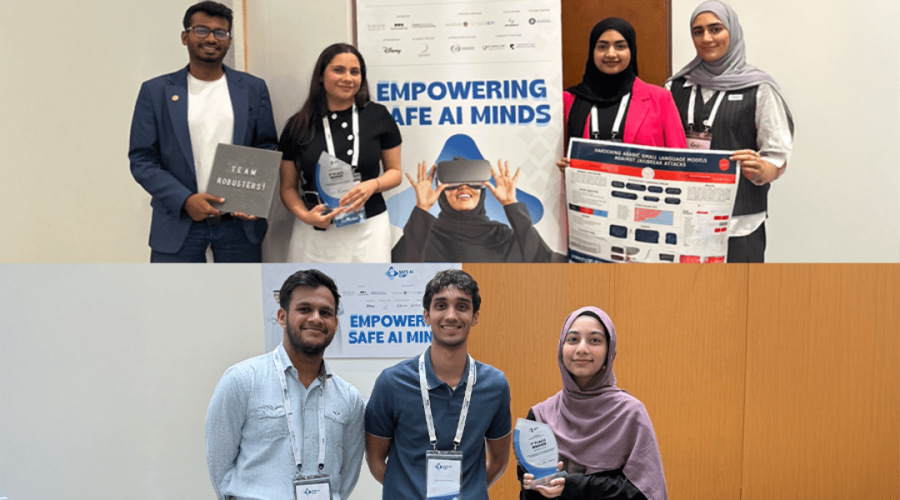
Top row: Third prize winning team. Bottom row: First prize winning team
Two student teams from American University of Sharjah (AUS) have secured first and third place at the Safe AI Cup. The competition is one of the UAE’s premier student competitions focused on responsible and ethical innovation in generative AI. Co-organized by the Emirates Safer Internet Society (eSafe), the Robotics and Automation Society (RAS) and Global Innovation & Entrepreneurship (GIE), the event aligns with the UAE National Strategy for Artificial Intelligence 2031. The 2026 edition’s University Track challenged participants to build functional, high-level AI prototypes designed to address real-world technological risks while creating a meaningful impact.
AI for real-time inclusive learning support
First place was awarded to the AUS team of Syed Muhammad Moosa, Nabeeha Fatima and Muhammad Hasher, recent Bachelor of Science in Computer Science graduates, for their real-time educational prototype called Lens. Advised by Dr. Samer Nofal, Associate Professor in the Department of Computer Science and Engineering, the team targeted a critical gap in existing assistive technologies for neurodivergent students.
Attention Deficit Hyperactivity Disorder (ADHD) and dyslexia are common neurodevelopmental conditions that can impact students’ learning. Since most digital solutions available provide learning assistance only after the class has concluded, the team aimed to create a solution that can provide immediate support.
“We knew from the start that we wanted to build something for students with ADHD and dyslexia because these students are just as capable and intelligent as their peers, but they often lack the support and learning environment they need to thrive,” explained Fatima. “As we researched existing solutions, we noticed a common gap that most tools provide assistance only after class rather than when students need it most, during the lesson itself. That insight became the foundation of our framework and we designed Lens to provide real-time support to help students stay engaged, follow along with the material and participate confidently in class.”
The group built a Natural Language Processing (NLP) pipeline focused on text simplification and semantic understanding. Operating on the student’s device locally, the software listens to the lesson, rewrites lecture sentences into clearer syntax while preserving facts and providing different fonts styles and sizes for better readability, detects complex terms that may require glossing and explains tapped words and generates comprehensive review notes.
Crucially, Lens incorporates multiple safety filters, including strictly isolated user profiles, sanitized inputs, user verification features and data deletion capabilities for privacy while allowing the school or governing authority control over end-user onboarding.
Reflecting on their achievement, Moosa said, “We feel truly honored and grateful to receive first place for Lens. This recognition means a lot to our team, as it reflects the effort, dedication and creativity we put into the project. We are also grateful to the AUS College of Engineering (CEN) community for providing an environment that encourages innovation, collaboration and meaningful problem-solving.”
The team also credited their supervisor's guidance as a vital catalyst. “Dr. Samer’s encouragement and belief in the idea gave the team the confidence to see it through. His constructive feedback at key stages helped the team refine and strengthen Lens and his support was instrumental in bringing the project to the standards of winning this prestigious competition,” Moosa added.
Looking forward, the team’s long-term vision is to refine the platform further and see it deployed across actual classrooms, making real-time and inclusive learning support accessible on a regional and global scale.
Cyber-securing regional language models
Third-place winners at the Safe AI Cup were the AUS team of Jana Abdelbaki, Habiba Elsayed and Tala Ali, second-year students in the Bachelor of Science in Computer Engineering program, and Sakina Bagalkot, a second-year student in the Bachelor of Science in Computer Science program. Guided by team advisor Dr. Imran Zualkernan, Professor of Computer Science and Engineering; technical mentor Ali Reza Sajun, lab instructor at the Department of Computer Science and Engineering; and AUS alumnus and project mentor Khalfan Alshamsi, the team engineered an advanced cybersecurity solution titled “Hardening Arabic Small Language Models Against Jailbreak Attacks on the Edge.”
The team’s submission specifically addresses the risk of jailbreak attacks, a technique where malicious users manipulate AI prompts to try to bypass system safety restrictions to generate harmful, biased or illegal content.
“We were inspired by the growing use of AI in the Arab world and the limited research on securing Arabic language models,” Abdelbaki highlighted. “We wanted to contribute to building safer Arabic AI systems that can be deployed efficiently on local devices.”
The group utilized OpenAI and Gemini models to act as automated attackers, simulating hostile, persuasive and adversarial jailbreak attacks against their system. By combining safety evaluation methods with reinforcement learning and persuasive fine-tuning techniques, the team significantly increased the robustness of their model, which was designed to actively detect and mitigate sophisticated attempts to exploit the software in ways that might produce harmful responses.. Since the whole system is engineered to be exceptionally lightweight, it runs efficiently on localized edge devices, providing an ethical, fair and scalable security solution for regional deployment without constant cloud connectivity.
“We were honored and excited to receive recognition for our work. Winning this award has highlighted the importance of AI safety research in the Arabic language space,” Elsayed mentioned. “Our supervisors and mentors provided valuable technical guidance, constructive feedback and support, without which we would not be able to win in such a competitive space against quality submissions,” said Ali.
Moving ahead, the group plans to further improve the framework, test it against additional evolving attack methods and explore opportunities for future research and journal publications.
This double-podium victory at the Safe AI Cup highlights the research being done in the fields of artificial intelligence, machine learning, neural networks, cybersecurity, computer engineering and other fields at the AUS College of Engineering.
To learn more about CEN, visit www.aus.edu/cen.
By continuing, you will be taken to a website not affiliated with American University of Sharjah. Links to external sites are provided only for users' convenience and imply no endorsement of the site and/or its content. Note that the privacy policy and security settings of the linked site may differ from those of the AUS website.