Latest News
October 1, 2026
September 30, 2026
September 29, 2026

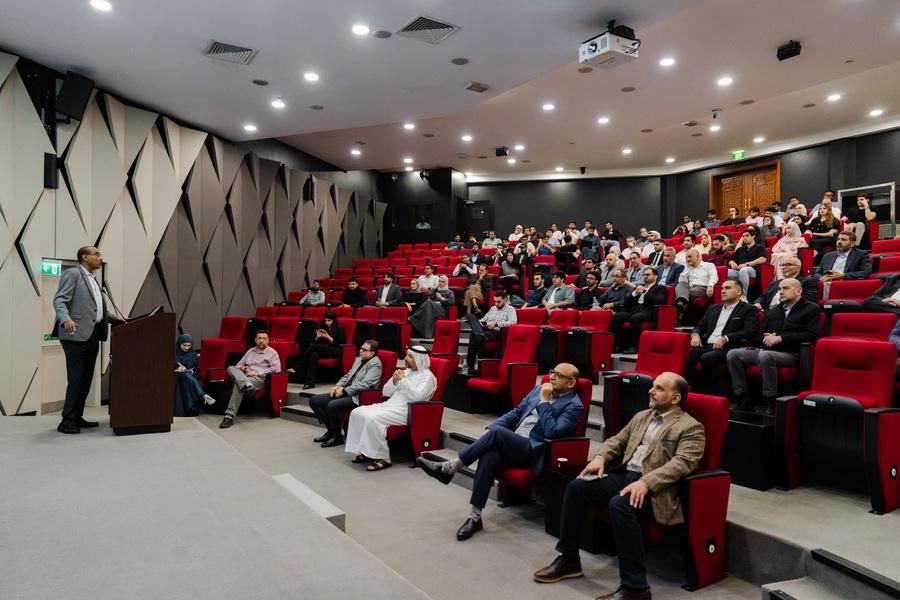
American University of Sharjah (AUS) College of Engineering (CEN) has invested AED 264,900 through its Undergraduate Research Grant (URG) program to support 52 student-led research projects in Spring and Fall 2025. Grant recipients and their faculty mentors were recognized in a ceremony held on campus, marking the growing culture of undergraduate research across the college.
In Spring 2025, CEN allocated AED 98,700 to fund 20 projects, followed by AED 166,200 in Fall 2025 to support 32 projects, reflecting strong and rising interest in undergraduate research among students. Across the two cycles, 65 proposals were submitted by CEN undergraduates, with 20 out of 24 proposals funded in spring and 32 out of 41 funded in fall.
Since its launch in Fall 2021, the URG program has aimed to position research as a core part of the college’s undergraduate learning experience. It gives students the opportunity to design and lead their own projects under faculty supervision, while developing skills in critical thinking, research methodology, independent work and teamwork. The program is open to all undergraduate students in CEN.
Dr. Fadi Aloul, Dean of CEN, described the URG initiative as a strategic driver of academic excellence and innovation at AUS.
“Undergraduate research transforms our students from consumers of knowledge into creators of knowledge,” he said. “Through the URG, our students learn how to identify real-world challenges, design robust methodologies and deliver results that matter to industry and society. In addition to these advantages, the URG better prepares students who are interested in pursuing graduate studies, where research plays a central role. This program directly supports the AUS 2025–2030 strategic objectives of advancing high-quality, interdisciplinary research and translating that research into practical solutions. When we invest in these projects, we are investing in the UAE’s long-term capacity for innovation and impact.”
The 2025 projects span a wide spectrum of emerging technologies and real-world engineering challenges. In spring, many teams developed intelligent systems and sustainable solutions, from virtual reality-enhanced engineering laboratories and smart driving assistance to AI tools for biodiversity monitoring, fire safety and industrial optimization. In fall, students built on this momentum with advanced water treatment concepts, AI-driven mobility and communication aids, secure and resilient digital systems, medical diagnostics innovations and space-oriented technologies, showcasing how AUS undergraduates are applying cutting-edge research to society’s most pressing needs.
Proposals are evaluated by a college-wide selection committee that assesses submissions on the basis of clarity, soundness of methodology or approach, budget justification, feasibility and potential impact.
Recent URG-supported projects have already generated concrete outcomes. A multi-sensor system to predict early signs of spinal diseases secured second place in Dell EMC’s regional competition “Envision the Future.” Another project on a low-cost platform with finger-operated pumping for microfluidic preparation of nanoparticles was presented at the 26th International Conference on Miniaturized Systems for Chemistry and Life Sciences in Hangzhou, China. A study on the thermal response of insulated GFRP-RC beams exposed to fire was featured at the First SCCEE International Virtual Conference on Sustainable Civil Engineering. These examples highlight how undergraduate research at AUS can evolve into work recognized atregional and international levels.
For many students, the URG program is a turning point in their academic journey. Among this year’s recipients is industrial engineering student Muhammad Vidha, a recipient of the prestigious 2025–2026 Sheikh Khalifa Scholarship. His URG-funded project, “Tariff Impacts on Supply Chains: A PRISMA-Guided Synthesis and a Tariff-Shock Adaptation Framework,” examines how modern tariff policies reshape global supply chains and how firms can respond. Through a PRISMA-guided systematic review of post-2018 research, he will consolidate evidence on how tariffs affect prices, sourcing decisions, inventory, lead times, network structures and export performance across sectors. Building on this, he will develop the Tariff-Shock Adaptation Framework, an evidence-based decision tool that helps firms and policymakers identify vulnerabilities, evaluate strategies such as trade diversion or reshoring and design more resilient supply chains under sustained tariff uncertainty. The project aims to produce two journal papers and a practitioner-focused framework particularly relevant to highly import-dependent economies such as the UAE and the wider Gulf region.
“Research has shaped my journey at AUS from my very first semester,” said Vidha. “The URG takes that experience to a different level. It gives students like me the chance to work closely with faculty, ask harder questions and contribute to real knowledge rather than just learning about it in class. This kind of support shows us that our ideas matter and that we can make a meaningful impact as undergraduates.”
Vidha’s connection to research at AUS extends beyond the classroom and the laboratory. Last summer, he travelled to Atlanta, Georgia, to represent AUS at a major research conference, where he presented his work, attended technical sessions and engaged with academics and professionals from around the world. Experiences like these illustrate how early engagement with research can prepare AUS undergraduates to participate confidently in global conversations on complex challenges.
Vidha’s project is supervised by Dr. Zied Bahroun as primary advisor and Dr. Vian Ahmed as co-advisor, both faculty members in the Department of Industrial Engineering.
The next call for URG proposals will open at the beginning of Spring Semester 2026. To learn more about the URG program, click here.

By continuing, you will be taken to a website not affiliated with American University of Sharjah. Links to external sites are provided only for users' convenience and imply no endorsement of the site and/or its content. Note that the privacy policy and security settings of the linked site may differ from those of the AUS website.