Latest News
October 22, 2026
October 21, 2026
October 20, 2026

Guardian of the Well directed by Professor Brown highlights climate change in Chad at Clermont-Ferrand, Torino, and Red Sea
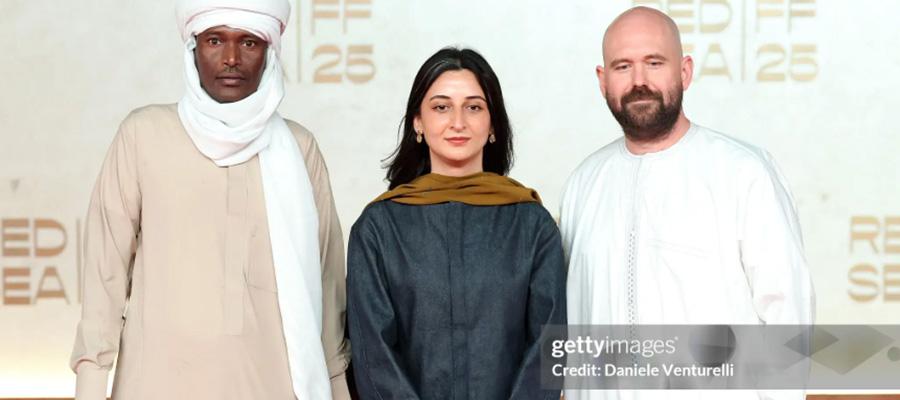
Photo caption: From left to right: Tahir Ben Mahamat Zene, Hala Al-Ani, and Bentley Brown at the Yusr Awards Ceremony of the Red Sea International Film Festival © Getty Images
A short film by an American University of Sharjah (AUS) professor is gaining international attention on the global film festival circuit, bringing renewed focus to the human impact of climate change in Chad.
Guardian of the Well (Biir Gardi), directed by Dr. Bentley Brown, Assistant Professor of Media Communication in AUS’ College of Arts and Sciences (CAS), has screened at major international film festivals and received nominations and awards across several leading documentary platforms. The six-minute short, which premiered earlier this year at True/False Film Festival in the United States, has recently been nominated for Best Short Film at the Red Sea International Film Festival, the Torino Film Festival and the Ji.hlava International Documentary Film Festival, and screened at Film Africa in London. Among its upcoming screenings are the international documentary film festival FIPADOC in France, Big Sky Documentary Film Festival in the United States, and the Clermont-Ferrand International Short Film Festival, the world’s largest festival for short films.
Set in Chad during the worst drought in half a century, followed by the heaviest rains in 25 years, Guardian of the Well centers on Biir Gardi, a historic well still used by herders today. Through immersive sound design and a restrained visual language, the film captures the tension between drought and flood, hope and loss, as communities navigate the collapse of traditional pastoral livelihoods. Once-settled areas have been abandoned, livestock numbers have fallen dramatically, and families are increasingly forced to choose between herding traditions and uncertain attempts at farming amid flooding.
The film opens with wide shots of a green desert. “This used to be a big town,” says a man standing at the well. “But then all the livestock died.” Later, he explains that he now has no cattle and is “living off God’s grace.” Throughout the film, grass homes are dismantled and fed to the remaining cattle, while the repetitive thud of a pulley drawing water from the well underscores the daily labor required simply to endure.
Guardian of the Well forms the first part of a trilogy that will go on to explore flooding, pastoralist traditions and ancient stargazing practices, expanding the narrative to examine environmental instability and our relationship to nature from multiple perspectives.
The project emerged from a long-standing personal connection between Dr. Brown and co-director Tahir Ben Mahamat Zene, who grew up together in Chad’s central Batha region. What began as a conversation about coexistence amid resource scarcity evolved into a planned trilogy of short films examining climate change and lived experience across the Sahel. The trilogy has been shaped by the creative contributions of collaborators, including Director of Photography Gabriel D. Lee, Second Camera Daniel Egnal, and Assistant Director Abdelsalam Brahim, a close friend and collaborator who has since passed away and is deeply missed by the team.
Reflecting on the project, Dr. Brown said: “Film allows us to bear witness to realities that are often overlooked. A defining aspect of Guardian of the Well and the next two films in the trilogy is that they feature varieties of Chadian Arabic rarely seen on screen, capturing conversations that convey practical and cultural knowledge, from operating a water well and crossing rivers to interpreting seasonal change through celestial observation. In doing so, the films challenge narrow or simplistic ideas of what ‘Arab’ identity looks like and highlight communities that are frequently excluded from regional narratives.”
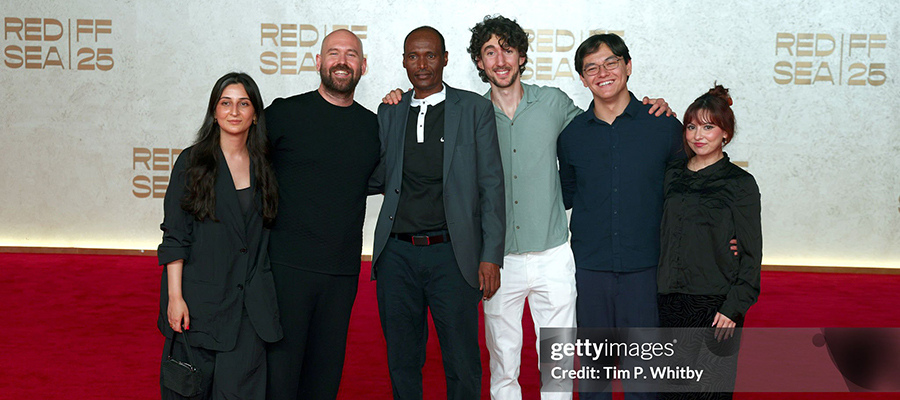
The Red Sea International Film Festival premiere in Jeddah marked a particularly significant moment for the filmmakers. It was the first time co-director Tahir Ben Mahamat Zene was able to attend and present the film in person alongside the creative team, after being unable to travel to earlier screenings due to visa restrictions.
The film was supported through AUS research funding, and reflects the university’s commitment to creative scholarship that bridges research, storytelling and critical social issues. Dr. Brown teaches several film and media courses at CAS, including courses on content creation, documentary practice, and production methods. To learn more about these and other CAS media communication programs, visit www.aus.edu/cas/media-communication.
By continuing, you will be taken to a website not affiliated with American University of Sharjah. Links to external sites are provided only for users' convenience and imply no endorsement of the site and/or its content. Note that the privacy policy and security settings of the linked site may differ from those of the AUS website.